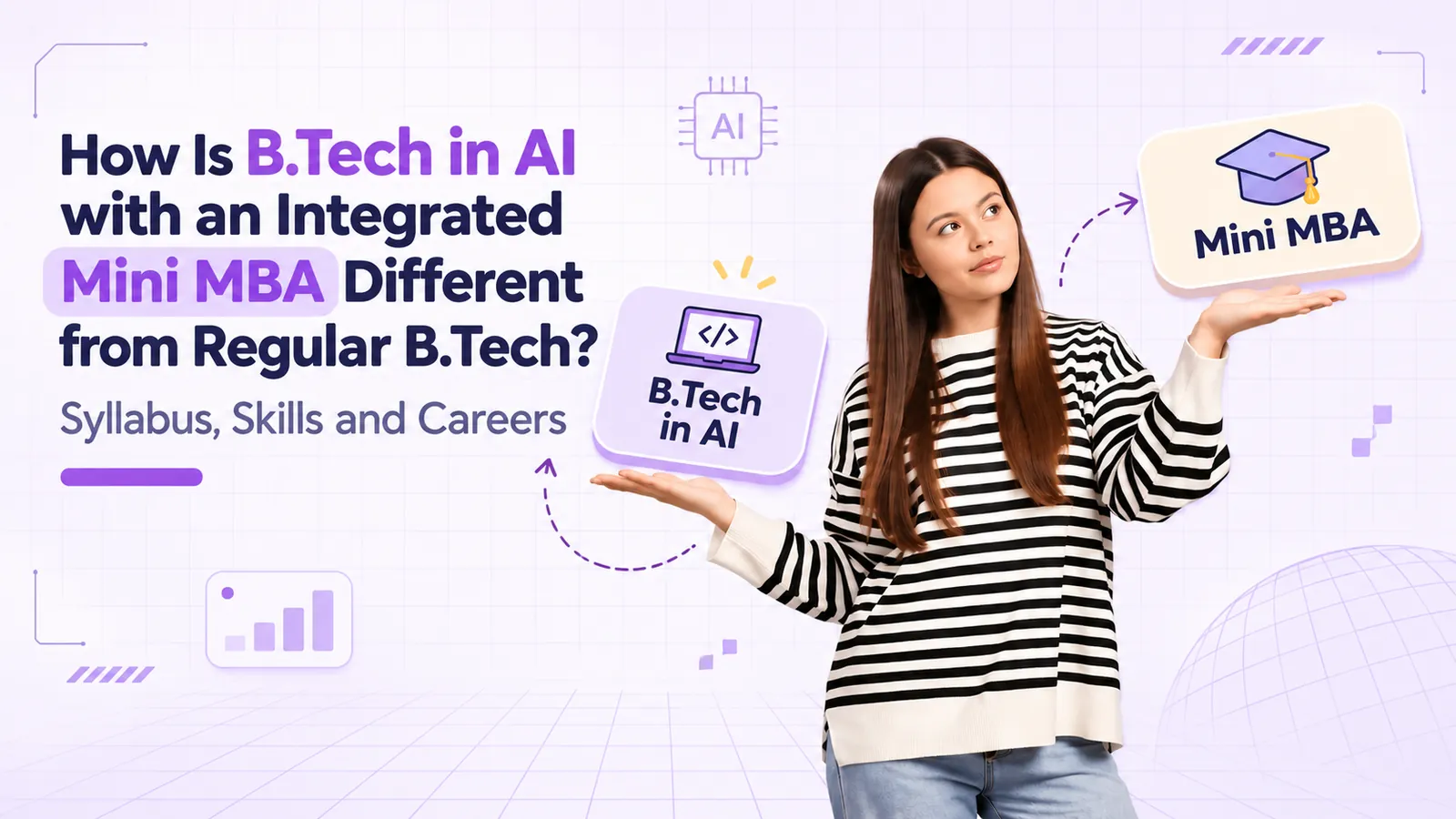
How Is B.Tech in AI With an Integrated Mini MBA Different From Regular B.Tech? Syllabus, Skills, and Careers
Between board exams and entrance coaching, everyone suddenly has an opinion on your engineering branch. A relative rings up and says, "Just opt for CSE." Then you come across a B.Tech in AI and wonder if it's the same degree with a fancier name. It isn't.
The difference between B.Tech and B.Tech AI shows up in what you study, the skills you build, and the work you can take up after graduation. Add an Integrated Mini MBA, and there's another dimension to consider. Here's how they compare.
What Does a Regular B.Tech Look Like?
A regular B.Tech is a four-year engineering degree in a branch such as Mechanical, Civil, Electronics, or Computer Science. The first year is largely common across branches, covering Physics, Chemistry, Mathematics, basic programming, and engineering drawing, as laid out in AICTE's model curriculum.
From the second year, you study subjects specific to your branch. In Computer Science, these include data structures, operating systems, and computer networks. Machine learning often appears as an elective in later years, with internships and projects gaining weight toward the end. This builds a broad engineering foundation, though deeper AI specialization may require additional electives or training.
What Makes a B.Tech in AI Different?
In a B.Tech in AI, AI is a core part of the degree, not an elective you pick up later. That's the main difference between B.Tech AI and traditional B.Tech. You start early with Python, data structures, probability, and linear algebra, building toward machine learning and deep learning.
AI Engineering vs. General Engineering
The two also differ in the kind of problems you learn to solve:
- General engineering: You design systems using established principles, such as load limits in structural engineering or circuit laws in electronics.
- AI engineering: You build systems that learn patterns from data, then test whether their predictions and decisions can be trusted.
B.Tech AI vs. Traditional B.Tech: How the Syllabus Compares
The two share some subjects, but their focus differs:
| Area | Regular B.Tech (CSE, for example) | B.Tech in AI |
|---|---|---|
| Math | Calculus, discrete math, basic statistics | Linear algebra, probability, optimization from early on |
| Programming | C, Java, data structures | Python, data structures, ML libraries |
| Core subjects | OS, networks, databases, compilers | ML, neural networks, NLP, computer vision |
| AI exposure | Usually an elective in later years | Part of the core, every year |
| Projects | Mostly academic | Datasets, model building, deployment |
So, what do you study in AI engineering? Alongside engineering mathematics and core computer science, the course typically covers model training, data pipelines, deploying models through APIs, and AI ethics.
Skills You Build Along the Way
How is B.Tech AI different when it comes to skills? A regular B.Tech trains you to think like an engineer: break down problems, understand fundamentals, and apply them across domains. A B.Tech in AI builds on that and adds practical skills such as cleaning messy data, choosing and evaluating models, and knowing when a model shouldn't be trusted. Employers look for these too: the Nasscom–Indeed report lists Python and machine learning among the top skills sought for high-paying AI jobs in India.
Whichever path you pick, what you build matters more than the degree title. A GitHub profile with a few well-built projects can tell employers more than a long list of subjects.
Where Does the Mini MBA Fit In?
Many engineers pick up business skills years later, often after moving into managerial roles or pursuing an MBA. A B.Tech AI with Mini MBA brings this learning into the degree itself. Alongside technical subjects, you study finance, marketing, operations, and product management.
AI engineers rarely work alone. They sit with product managers, founders, and clients who may ask, "What will this model save us?" A technical answer won't always be enough, and a Mini MBA helps you make a stronger business case for what you build.
Career Options: Which Degree Should You Choose?
The career paths can help you understand how B.Tech AI is different from a regular engineering degree:
- Regular B.Tech: Opens up software development, core engineering, and higher studies such as an M.Tech or MBA.
- B.Tech in AI: Prepares you for specialized roles such as AI engineer, machine learning engineer, data scientist, and NLP engineer.
Neither closes doors. Graduates of both can appear for GATE, which leads to M.Tech admissions and PSU jobs, though each PSU sets its own discipline requirements. A CSE graduate can also move into AI by learning machine learning separately. An AI degree simply builds it into the course.
Demand is rising as well. A Deloitte–Nasscom report projects India's AI talent demand will grow from about 6–6.5 lakh professionals to 12.5 lakh by 2027.
If you're weighing B.Tech AI vs. traditional B.Tech, consider what interests you more: a broad engineering foundation or an early focus on AI.
Final Thoughts
Don't choose your four-year program based on a trend. Think about what you want to be doing at 9 a.m. on a Tuesday four years from now. When comparing any AI college in India, look beyond the course name and understand the scope of B.Tech in India before making your decision. Check the curriculum, when students get their first internships, and what they have actually built by graduation.
Zenith School of AI offers a B.Tech in AI with internships and externships from the first year, global immersions, and a Mini MBA. To learn more, reach the admissions team at +91 92666 12266 or admissions@zenithschool.ai.
FAQs
Not necessarily. You'll spend more time on math, coding, and data, so if you enjoy these, you'll likely settle in easily.
Yes. Many CSE graduates do it through online courses, projects, and a master's degree, though it takes more self-driven effort.
No. Basic Python helps, but good programs teach you from scratch.
Yes, especially for leading teams, joining startups, or product roles.
Physics and Mathematics are generally required for B.Tech AI, as they are for Computer Science under AICTE norms. The third subject varies by college, so check each one's eligibility criteria.
Related reading: B.Tech AI vs B.Tech CSE vs B.Tech Data Science: Which One Should You Actually Pick?
Disclaimer: B.Tech degree is awarded by K.R. Mangalam University. NAAC A Grade, UGC Recognized. All rights reserved by Nexus Global Intelligence and Education Pvt. Ltd. This blog is for general educational purposes only. Please verify program details, eligibility, and admission information on the official website before making any decision.