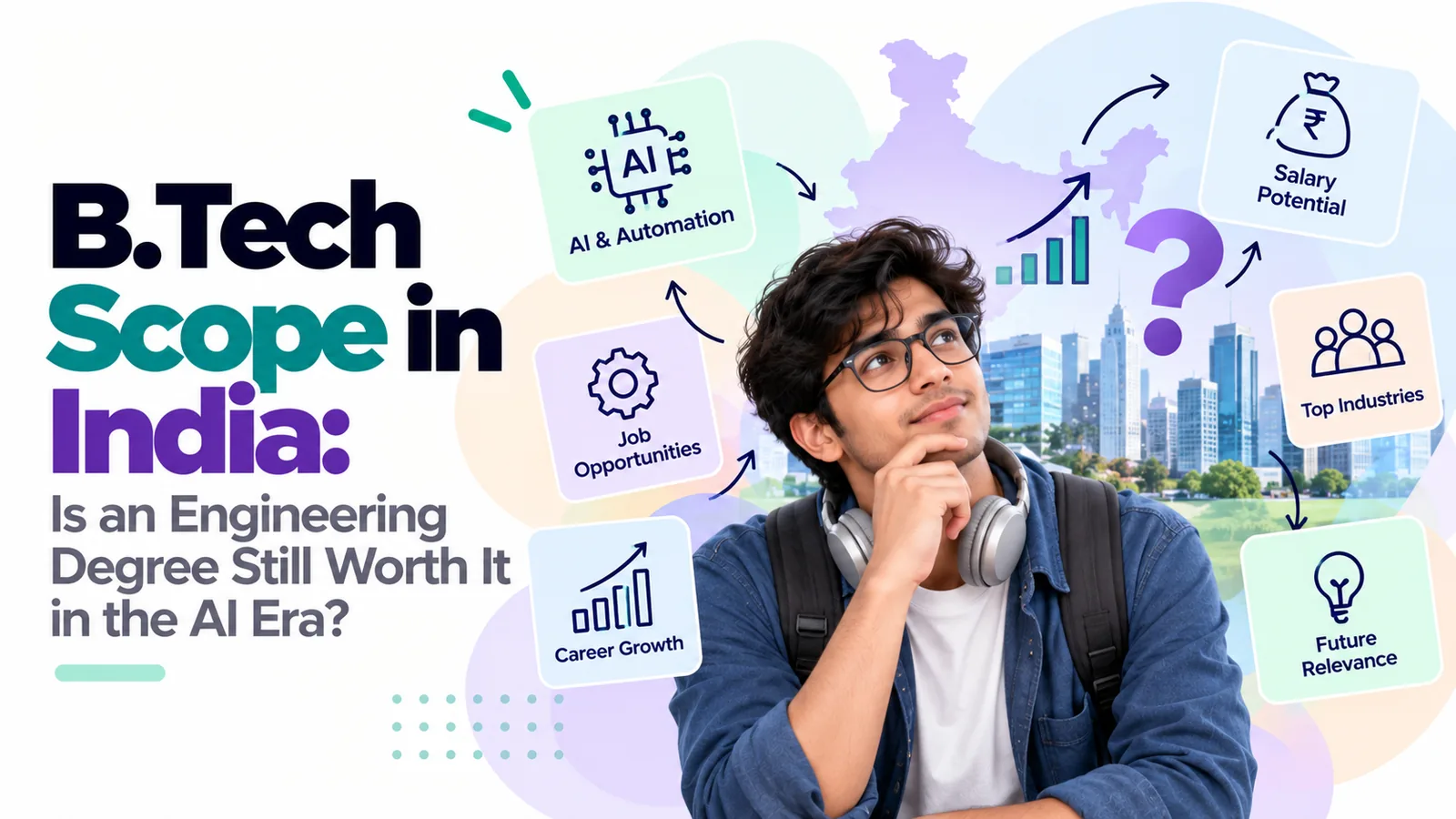
B.Tech Scope in India: Is an Engineering Degree Still Worth It in the AI Era?
As technology evolves at lightning speed, many students and parents wonder the same question: Is B.Tech still worth it in 2027? With the rise of Artificial Intelligence (AI), automation, and new technology routes transforming markets, some believe traditional engineering degrees are becoming outdated. But when you look at how B.Tech programmes have changed and what employers really want today, the answer isn't a simple yes or no.
How B.Tech Programmes Are Evolving for the Future of Engineering
A Bachelor of Technology (B.Tech) is a four-year undergraduate engineering programme that builds technical expertise, problem-solving abilities, and practical skills. Today, Artificial Intelligence (AI) has become an important part of modern B.Tech education, alongside emerging fields such as data science, robotics, cybersecurity, and cloud computing.
While traditional programmes focused mainly on mechanical, electrical, and civil engineering, newer B.Tech programmes are increasingly designed around the technologies shaping the future of engineering.
Zenith School of AI in Gurugram is a good example of what this shift looks like in practice. Its four-year B.Tech in AI (awarded by K.R. Mangalam University, a NAAC A-grade, UGC-recognised university) is built around AI from Semester 1 itself, starting with programming foundations and linear algebra for AI, and moving through classical machine learning, LLM-based systems, deep learning, reinforcement learning, and a capstone where students build and ship a real AI product.
Layered on top of the core engineering curriculum is a Mini MBA covering product, GTM, finance, and operations, plus mandatory paid internships and industry "externships" with 30+ partner companies from year one.
B Tech Scope in India: What the Numbers Actually Show
The B Tech scope conversation usually gets stuck between two extremes: "engineering is dead because of AI" on one side, and "engineering is always safe" on the other. Neither is accurate.
What's really happening is a redistribution of opportunity:
-
Roles that involve repetitive, rule-based coding are shrinking: Basic manual testing, boilerplate front-end work, and simple data entry are increasingly automated.
-
Roles that involve building, training, deploying, and securing AI systems are expanding rapidly: Machine learning engineers, AI product engineers, data engineers, MLOps specialists, and applied AI researchers all fall in this group. AI/ML hiring on Naukri grew 25% year-on-year in June 2026, and the share of Indian job postings on Indeed that mention AI rose from 8.2% in September 2024 to about 14% in January 2026, according to Indeed and Nasscom's 2026 AI talent report.
-
Core engineering branches with a strong AI or automation layer are outperforming their traditional counterparts: Mechanical engineers who understand robotics and automation, civil engineers who work with AI-driven design and simulation tools, and electrical engineers who understand smart grids and embedded AI are in a noticeably stronger position than peers with a purely traditional skill set.
So the scope of a B.Tech degree in 2026 isn't shrinking; it's concentrating. It's concentrating around AI, data, automation, and the branches that have absorbed these skills fastest. A B.Tech in Artificial Intelligence sits at the centre of that shift, because it builds these skills into the core curriculum.
Why an Engineering Degree Still Pays Off: The Benefits of Doing A B.Tech
Even with all the disruption, there are concrete benefits of doing a B.Tech that haven't gone away; they have just shifted in nature.
Structured, In-Demand Technical Foundation
A B.Tech still gives you four years of structured exposure to mathematics, logic, systems thinking, and problem-solving that's hard to replicate through short courses alone. This foundation is what lets engineers pick up new tools quickly, including AI tools, instead of being left behind by them.
Access to Campus Placements and Internships
Placement cells, internship pipelines, and recruiter relationships remain one of the biggest practical advantages of a B.Tech over a self-taught path. Programmes that build internships into the curriculum from the first year, such as Zenith School of AI's paid internships from year one, give students industry experience long before final placements begin.
A Recognised, Portable Credential
A UGC-recognised B.Tech degree still opens doors that skill certificates alone don't. This includes higher studies abroad, government exams, regulated industries, and roles where a formal engineering qualification is a hard requirement.
Peer Network and Mentorship
Four years alongside motivated peers, faculty, and, increasingly, industry mentors build a professional network that pays off for the rest of a career. This is genuinely hard to replace with online learning alone.
A Safer Path into Entrepreneurship
Many modern B.Tech programmes now bundle in business fundamentals. Zenith School of AI's integrated Mini MBA is one example of how engineering education is starting to double as founder education. This reduces the traditional gap between "knows how to build" and "knows how to build a business."
How Other Engineering Branches Compare
To be clear, B.Tech in AI isn't the only branch worth considering. Each branch's scope now depends partly on how much AI and automation it includes.
-
B.Tech in Artificial Intelligence: This is the branch built around the technology that every other branch is now racing to catch up on. Instead of treating AI as an elective or a self-taught add-on, an AI-specialised B.Tech puts machine learning, data engineering, and applied AI projects at the centre of the curriculum from year one. That means graduates aren't just aware of AI; they can design, train, and deploy it, which is precisely the skill set recruiters across every sector are short on.
-
Computer Science Engineering (CSE): Still a strong and versatile choice, and closely related to AI, which is exactly why the comparison is worth making. CSE graduates still have solid scope across software, systems, and product roles, but for the highest-paying AI-specific roles, they increasingly compete directly with AI-specialised graduates and often need to build ML/AI skills on their own, outside the core curriculum, to stay competitive. For a closer look at the two, see our B.Tech AI vs CSE vs Data Science comparison.
-
Electronics & Communication (ECE): Solid scope in semiconductors, embedded systems, IoT, and telecom. But the branch is only as strong as its AI layer; ECE graduates who understand AI/ML for smart devices and edge computing get the best roles.
-
Mechanical Engineering: Traditional core-sector scope remains steady, but the real growth is in robotics, automation, and AI-driven design and simulation, all of which sit closer to AI than to classical mechanical engineering.
-
Electrical Engineering: Power systems and smart-grid roles are evolving fast, but the strongest demand is specifically for engineers who can add automation and AI-based monitoring skills on top of core electrical knowledge.
-
Civil Engineering: Still essential for infrastructure and real estate growth in India, but the higher-value, forward-looking work — structural simulation, project management, and smart-city design — is increasingly AI-driven.
The Bottom Line
B.Tech isn't becoming obsolete in the AI era; it's being redefined by it. The degree itself hasn't lost value; what's changed is which version of the degree delivers that value. Programmes that treat AI as a core, semester-by-semester subject, combined with real internships, industry projects, and business fundamentals, are designed to produce graduates who are more employable, not less, in a market where AI is reshaping every industry.
If you're a student or a parent weighing this decision in 2027, the question isn't "should I do a B.Tech." It's "which B.Tech will actually prepare me for the next decade of work?" Programmes like the B.Tech in AI + Mini MBA at Zenith School of AI are one example of what that version of an engineering degree can look like: AI-native from semester one, backed by paid internships, industry mentorship, and a business layer most traditional B.Tech programmes still don't offer.
What to Do After Completing B.Tech?
A B.Tech opens several routes after graduation. The most common are:
-
Jobs and campus placements: Join a company through campus placement or apply off-campus. This is the route most graduates take.
-
M.Tech or MS abroad: Clear GATE for an M.Tech at the IITs, NITs, and other Indian institutes, or take the GRE for a master's abroad.
-
MBA: Take CAT or GMAT to move into management, product, or consulting, usually after a couple of years of work experience.
-
PSU jobs: Public sector companies such as ONGC, NTPC, and BHEL recruit engineers through GATE scores.
-
Starting up: Build a product or company of your own, using the technical skills and network from your degree.
FAQs
Yes, but with a caveat: a B.Tech is worth it when the curriculum has genuinely adapted to AI and industry needs. Traditional, unchanged syllabi are losing relevance faster than the degree itself.
AI and Computer Science currently have the fastest-growing demand, driven by AI hiring. Electronics, Electrical, Mechanical, and Civil retain solid scope, especially when combined with automation, robotics, or AI skills. The best branch for you depends on your interests and strengths.
AI is automating repetitive, rule-based tasks, not engineering judgment itself. It's actually increasing demand for engineers who can build, train, deploy, and manage AI systems, which is why AI/ML hiring in India keeps growing year on year.
A structured technical foundation, access to campus placements and internships, a recognised UGC degree, a strong peer and mentor network, and (in newer programmes) built-in business and entrepreneurship training.
When it's awarded by a UGC-recognised university, yes. For example, Zenith School of AI's B.Tech in AI is awarded by K.R. Mangalam University, a UGC-recognised, NAAC A-grade institution, so it carries the same formal recognition as any other B.Tech degree.
In an AI-native programme, machine learning, deep learning, and applied AI are core subjects spread across all eight semesters, rather than one or two electives. This depth is usually paired with more AI-focused projects, internships, and industry exposure.
Yes, data structures and algorithms, operating systems, computer networks, databases, and system design remain part of the curriculum. AI is layered on top of these fundamentals, not built instead of them.
Related reading: B.Tech in Artificial Intelligence: The Complete 2027 Guide
Disclaimer: B.Tech degree is awarded by K.R. Mangalam University. NAAC A Grade, UGC Recognized. All rights reserved by Nexus Global Intelligence and Education Pvt. Ltd. This blog is for general educational purposes only. Please verify program details, eligibility, and admission information on the official website before making any decision.