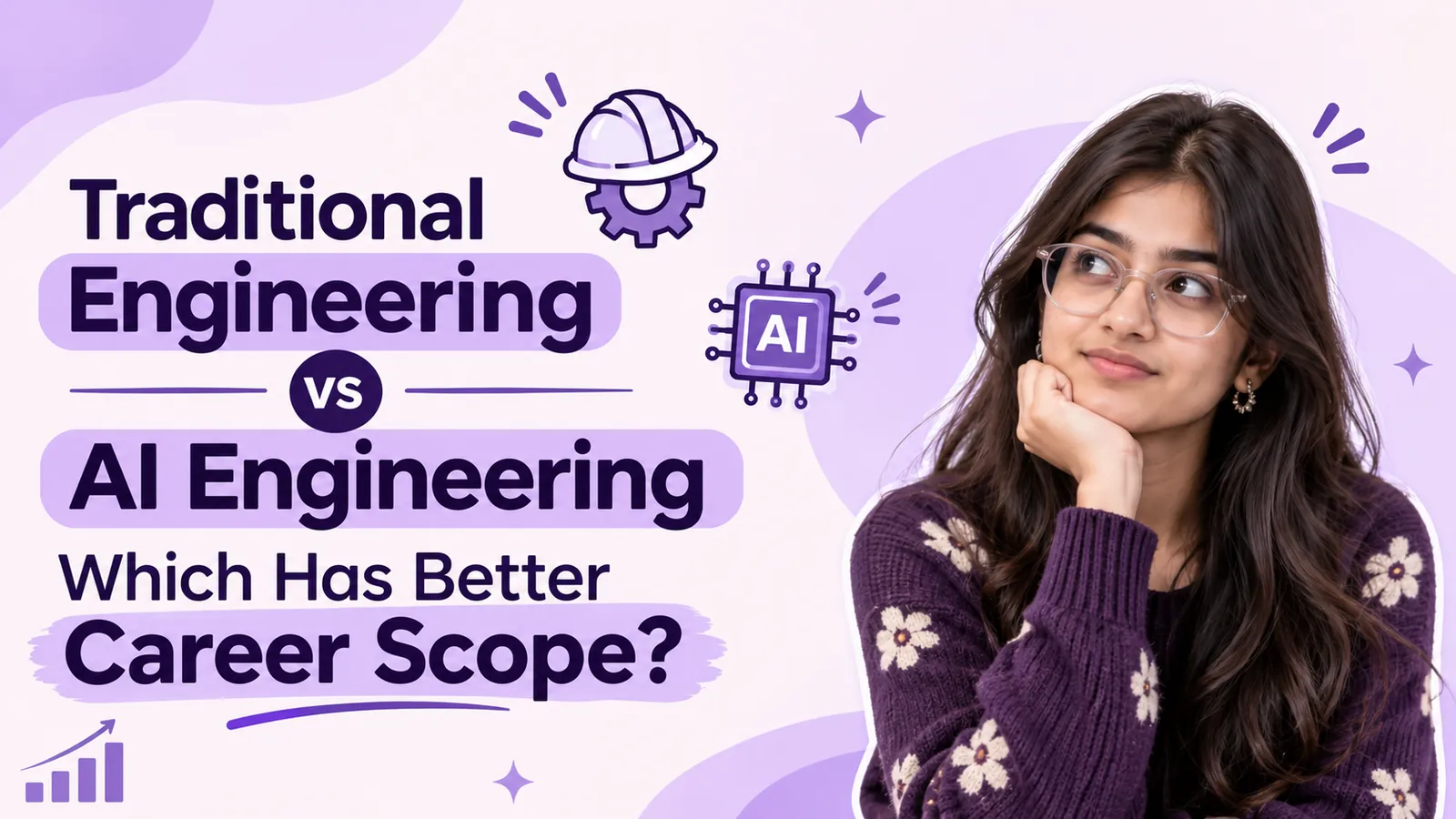
Traditional Engineering vs. AI Engineering: Which Has Better Career Scope?
You're in Class 11 or 12, JEE Main is on your radar, and the big question is which B.Tech branch to choose. Your parents suggest mechanical or civil engineering. Your friends say AI is the future. Suddenly, a decision that should be about your interests feels like a discussion everyone else is having for you.
So, where does that leave you? The traditional engineering vs. AI engineering debate comes down to the problems you want to solve and the career you want to build. Here is what each path involves and how to decide.
What Are Traditional and AI Engineering?
Traditional, or core, engineering covers mechanical, civil, electrical, electronics, and chemical branches. These fields build the machines, buildings, roads, and power systems we rely on.
AI engineers build software systems that learn from data, such as recommendation engines, bank chatbots, or systems that spot defects on a production line. Instead of physical materials, you work with Python, machine learning models, and cloud tools.
Traditional Engineering vs. AI Engineering: Key Differences
Here's a quick comparison of how the two fields compare:
| Parameter | Traditional Engineering | AI Engineering |
|---|---|---|
| What you build | Physical structures, machines, and systems | Software, models, intelligent applications |
| Core subjects | Physics, mechanics, thermodynamics, design | Programming, statistics, machine learning |
| Where you work | Sites, plants, labs, design offices | Tech teams, startups, product companies |
| Tools | CAD, simulation software, instruments | Python, PyTorch, TensorFlow, cloud platforms |
| Pace of change | Gradual, standards-driven | Fast, with new tools every year |
Mechanical vs. AI Engineering
A mechanical engineer designs engines, robots, HVAC systems, and manufacturing lines, while an AI engineer builds the software that helps such systems work smarter, such as flagging a machine fault before it halts production.
When weighing mechanical vs. AI engineering, note the overlap. Electric vehicles and robotics need both skill sets, and the World Economic Forum (WEF) lists autonomous and electric vehicle specialists among the 15 fastest-growing roles by 2030.
Civil vs. AI Engineering
Civil engineers work on buildings, roads, dams, and water systems, where budgets, deadlines, and safety decisions directly affect people's lives. AI can help monitor bridges, predict project delays, and manage traffic, but software cannot take responsibility for structural safety. In the civil vs. AI engineering comparison, AI is a tool for civil engineers, not a replacement.
Core Branches vs. AI: What You'll Study
When comparing core branches vs. AI, look at the four-year syllabus, not just the branch name.
- Core branches: Engineering mathematics, mechanics, materials, circuits or structures, and design, with lab work and workshops.
- AI: Programming, data structures, linear algebra, probability, machine learning, and deep learning, with project-based coding.
JEE Main requires Physics and Mathematics, plus one of Chemistry, Biology, Biotechnology, or a Technical Vocational subject, so your Class 11 and 12 subjects prepare you for either choice. Colleges may set their own criteria, so check each one. If you lean toward AI, learn Python alongside your regular studies.
AI Engineering vs. Core Engineering: Career Scope
On job prospects, the WEF's Future of Jobs Report 2025 ranks big data specialists and AI and machine learning specialists among the fastest-growing roles by 2030, and places environmental and renewable energy engineers in the top 15. These are global employer-survey projections, not job guarantees for India.
Core fields offer stable demand, government and PSU opportunities, and clear career ladders. However, entry-level openings in some branches are competitive, so internships, projects, and skills matter.
On pay, AI tends to lead, with freshers in India earning around ₹5–8 LPA and mid-level professionals earning ₹12–25 LPA. Traditional engineering salaries are usually lower, although they vary across branches. Freshers can expect around ₹3–5 LPA, and mid-level civil engineers, for example, earn around ₹5–8 LPA. Earnings in both fields depend on skills, employer, location, and experience, and AI roles require continuous upskilling.
Sources: EICTA Consortium, "AI Engineer Salary in India 2026"; Naukri Campus, "Sectors Hiring Freshers in India"; AmbitionBox, Senior Civil Engineer salaries. Checked November 2026.
For a fuller breakdown of AI pay by experience, city, and employer, see our guide to the AI engineer salary in India.
Is AI Better Than Core Engineering?
Many students ask, "Is AI better than core engineering?" AI has an edge in salary potential and emerging roles, but core engineering still offers strong careers in infrastructure, manufacturing, and energy. The right choice depends on your interests.
- Choose AI engineering if you enjoy coding, mathematics, and data, and are comfortable learning new technologies as the field evolves.
- Choose core engineering if you are drawn to machines, structures, electrical systems, or hands-on projects.
You can also switch later. Mechanical and civil engineers can learn AI, while AI graduates can apply their skills to manufacturing, construction, and energy.
Final Thoughts
Your choice between traditional engineering and AI engineering will shape the subjects you study and the problems you learn to solve. Think about whether you see yourself writing code and developing AI systems or working with machines, structures, and physical infrastructure.
If AI interests you, explore what an AI college in India offers. Zenith School of AI's B.Tech program includes internships and externships from the first year, global immersions, and a Mini MBA. Contact the admissions team at +91 92666 12266 or admissions@zenithschool.ai to learn more.
FAQs
Both offer good career opportunities. AI engineering is seeing faster growth across industries, while traditional branches continue to find work in infrastructure, construction, and manufacturing.
Yes. You can learn Python, data analysis, and machine learning through courses and projects. Your core background can also help you apply AI to real industry problems.
No prior coding experience is necessary. You'll learn programming from the basics, and an interest in problem-solving and regular practice will help. Computer Science in school helps but isn't mandatory.
AI may take over repetitive tasks, but core engineers are still needed for design decisions, safety checks, and on-site challenges. Knowing AI tools can give graduates an advantage.
Related reading: Best Engineering Branches in India for 2027
Disclaimer: B.Tech degree is awarded by K.R. Mangalam University. NAAC A Grade, UGC Recognized. All rights reserved by Nexus Global Intelligence and Education Pvt. Ltd. This blog is for general educational purposes only. Please verify program details, eligibility, and admission information on the official website before making any decision.