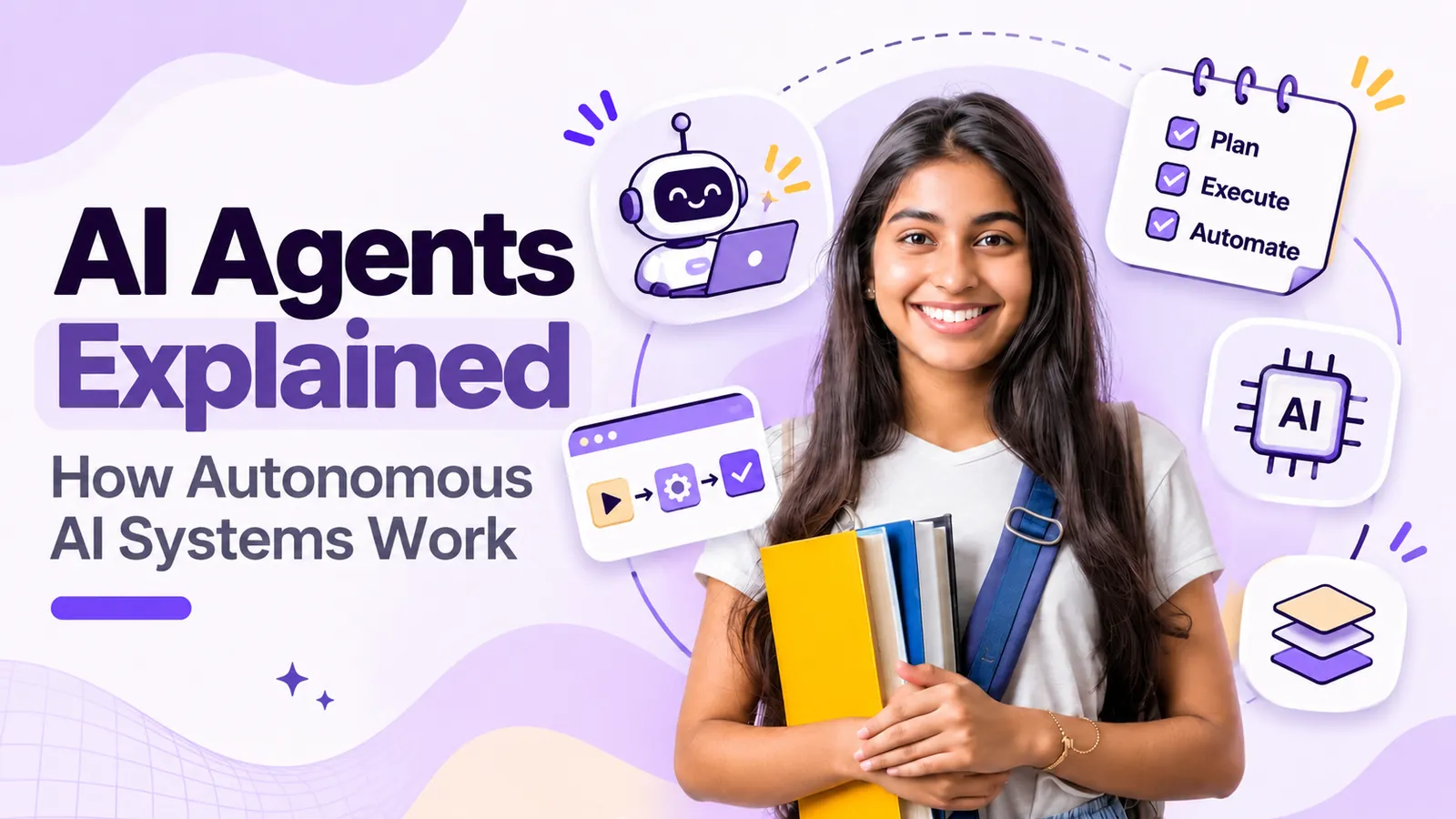
AI Agents Explained: How Autonomous AI Systems Work
Ask a chatbot to plan your Goa trip, and you'll get a tidy list of ideas. Then the real work begins. You are left with comparing flights, checking hotel prices, and booking everything yourself. Now imagine software that handles all of this while you revise for your board exams. That's the shift AI agents bring, moving from answering questions to taking action on your behalf. So, what are AI agents, and how do they work?
Here are AI agents explained through simple examples, with a look at what they mean for students considering a B.Tech in AI.
What Are AI Agents, Exactly?
AI agents are software systems that take a goal, decide the steps needed, use tools, and act with little hand-holding. Instead of answering once and stopping, an agent keeps going until the job is done or it needs your approval.
This approach is known as agentic AI, where the system chooses its next steps rather than waiting for instructions at every stage. Most autonomous AI agents are built on large language models (LLMs, the technology behind ChatGPT) and use tools such as web browsing, code execution, and app access.
How Do AI Agents Work?
Most agents follow a four-step cycle:
- Perceive: Read your goal and gather inputs, like emails or a database.
- Plan: Break the goal into smaller steps.
- Act: Use tools such as search, code, or APIs to carry out each step.
- Reflect: Check the result, fix mistakes, and loop again.
Memory ties it together, so the agent remembers what it has already tried.
AI Agents vs. Chatbots: How They Differ
A chatbot like ChatGPT or Gemini responds to your message and leaves the next step to you. An AI agent acts on your request by checking your calendar, emailing a vendor, or retrying a failed task. The line is blurring, though, as many tools combine both, using a chat window to receive instructions while an agent works in the background.
Understanding the Types of AI Agents
The five classic types of AI agents come from Stuart Russell and Peter Norvig's widely used textbook, Artificial Intelligence: A Modern Approach. Each follows a different approach to making decisions:
- Simple reflex agents: React to what's happening right now using set rules, like a thermostat switching on when a room gets cold.
- Model-based agents: Track their surroundings to make better decisions, like a robot vacuum that remembers which areas it has cleaned.
- Goal-based agents: Choose actions that achieve a specific outcome, like reaching a destination.
- Utility-based agents: Compare possible actions and pick the one with the greatest overall benefit, like a route planner weighing time and cost.
- Learning agents: Improve using past experiences and feedback, like recommendation systems learning your preferences.
AI Agents Examples and Real-World Applications
You may already be using AI agents without realizing it. Here are a few AI agent examples:
- Customer support: Agents can handle refund requests and check order details without a human managing every step.
- Software development: GitHub Copilot's agent mode can edit multiple files, run tests, and fix errors as part of a task.
- Self-driving vehicles: Waymo's robotaxis use autonomous AI to navigate roads in US cities and respond to traffic.
In workplaces, however, many agents still need human approval before making important decisions. Gartner predicts that by 2028, agentic AI will make at least 15% of day-to-day work decisions autonomously, compared with none in 2024. It also warns that over 40% of agentic AI projects will be canceled by the end of 2027 due to cost, unclear value, or weak risk controls.
Source: Gartner press release, "Gartner Predicts Over 40% of Agentic AI Projects Will Be Canceled by End of 2027" (25 June 2025).
How AI Agents Are Built
The basic ingredients are an AI model, tools it can use, and memory to track what it has done. AI agent frameworks such as LangChain, LangGraph, and CrewAI help developers connect these parts and manage how agents work together. Microsoft's Agent Framework does the same and succeeds its earlier AutoGen project.
Most of these frameworks are built for Python, so learning the language is a good starting point. You could even build a simple agent that collects and summarizes your daily cricket news as a weekend project.
Final Thoughts
If this interests you, start with the skills behind it, such as Python, machine learning, and APIs. A small Python project is a good way to practice before college.
When you're ready to go further, look for a B.Tech in AI that gives you room to work on real projects. Zenith School of AI, an AI school in India established in January 2026, offers a B.Tech in AI degree with first-year internships and externships, global immersions, and a Mini MBA. To learn more, visit zenithschool.ai, call +91 92666 12266, or email admissions@zenithschool.ai.
FAQs
Digital helpers that take a goal, plan the steps, and finish tasks using software tools, checking their own work along the way.
Basic programming, mainly Python, is important, but you don't need to be an expert yet. Most students pick it up during the first year of a B.Tech.
Unlikely. Agents handle repetitive tasks, while engineers design systems, review output, and fix what goes wrong. People who can work with agents will be in demand across emerging AI engineering careers.
Physics and Mathematics are required for most B.Tech branches under AICTE norms, usually alongside Chemistry or another approved subject. For AI, build a strong foundation in probability, matrices, vectors, and calculus.
Related reading: How Much Math Do You Need for AI? A Class 12 Student's Guide
Disclaimer: B.Tech degree is awarded by K.R. Mangalam University. NAAC A Grade, UGC Recognized. All rights reserved by Nexus Global Intelligence and Education Pvt. Ltd. This blog is for general educational purposes only. Please verify program details, eligibility, and admission information on the official website before making any decision.