How Much Math Do You Need for AI? A Class 12 Student's Guide
At every family gathering, someone says "AI is the future." Then someone else brings up the math involved and makes it sound as if you need to be a genius to pursue it. If you're preparing for your board exams, you may wonder whether your Math scores are good enough or whether you have a lot of catching up to do.
The good news is that you don't need advanced mathematics before you start. What matters is a sound grasp of the basics and a willingness to build on them. This guide explains how much math for AI you actually need, which topics you'll study during your degree, and how to strengthen your foundation while still in Class 12.
Is Math Required for AI?
Yes, but not to the extent most people imagine. AI models work with numbers, patterns, and probabilities to learn and make predictions, so math sits at the core of the field. You don't need to be an Olympiad topper, though. You need a handful of ideas that you understand well and can apply in code.
Think of it like driving a car. You don't need to know how to build an engine, but you should know what the brakes and accelerator do. Math for AI works in a similar way. You need to understand what each concept means and when to use it, while Python libraries handle much of the heavy number-crunching.
What Math Do You Need for AI and Machine Learning?
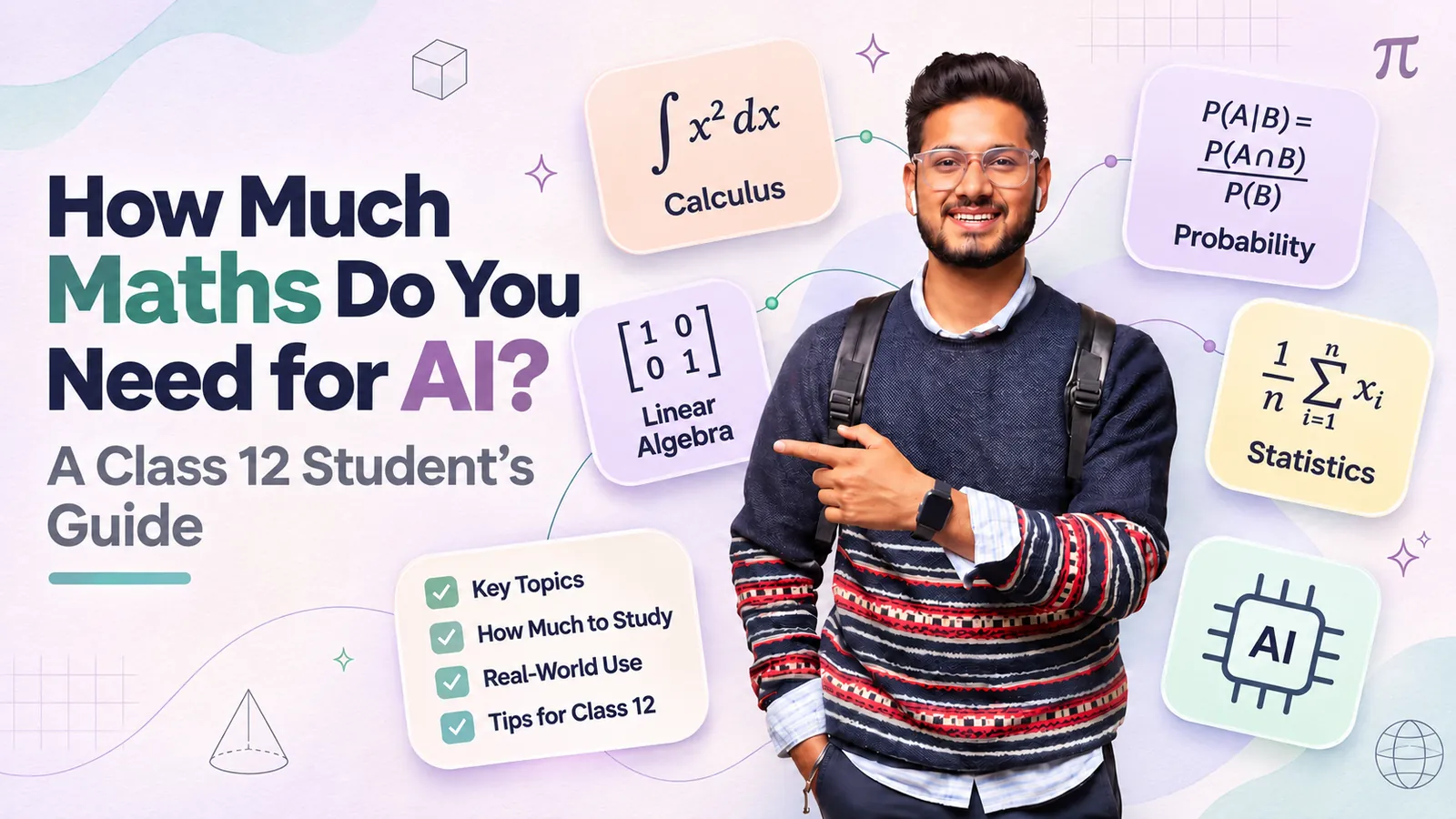
The math for AI and machine learning (ML) rests on four subjects. Each helps you understand how models process information, learn from data, and make predictions:
- Linear algebra: AI systems represent data such as images, text, and numerical inputs as vectors and matrices. You'll learn to work with these and perform matrix operations.
- Calculus: Derivatives show how much one quantity changes when another does. In AI, they help a model learn from its mistakes through a process called gradient descent, which adjusts the model's parameters step by step to reduce its errors.
- Probability: AI cannot always be certain about an answer. Probability helps it work out how likely something is, such as whether an email is spam.
- Statistics: Mean, variance, and probability distributions help you interpret data and judge how reliable a model's predictions are. These are the core concepts of statistics for AI.
Your Class 12 preparation already gives you a head start. The CBSE Class 12 Math syllabus covers matrices, determinants, calculus, vectors, and probability, and JEE Main preparation reinforces them. At degree level, you'll build on these topics as you study math for ML in more depth.
Can You Learn AI Without Math?
You can start learning AI even if math isn't your strongest subject. Ready-made AI tools and no-code platforms let you build simple applications without complex calculations. However, AI without math has its limits, because when a model gives the wrong answer, you'll need to understand why.
Is the data skewed or unrepresentative? Is the learning rate (the size of each learning step) too high? Without a mathematical angle, finding the cause becomes difficult. If you want to build and improve AI systems, rather than just use existing tools, a math foundation is essential.
What Does the AI Math Syllabus Look Like in B.Tech?
The AI math syllabus varies across universities, but many programs introduce the mathematical foundations in the first two years. Later semesters focus on applying them all in AI and ML. A typical pattern looks like this:
| Year | Common Math Subjects | Topics Covered |
|---|---|---|
| Year 1 | Calculus, Linear Algebra, Discrete Mathematics | Derivatives, matrices, vectors, functions, mathematical logic, and foundations of computing. Some programs also introduce probability and optimization. |
| Year 2 | Probability, Statistics, Optimization, Numerical Methods | Random variables, probability distributions, data analysis, statistical methods, and techniques for improving model performance. |
| Years 3 and 4 | Applied Mathematics in AI and ML | Mathematical concepts used in ML, deep learning, neural networks, reinforcement learning, and AI projects. |
Source: B.Tech in Artificial Intelligence curriculum, IIT Hyderabad, checked November 2026. Subjects and sequencing vary by university.
You may already have studied some of these topics in Classes 11 and 12, particularly calculus, matrices, and probability. B.Tech builds on that foundation and shows you how math for AI and ML applies to model training and prediction.
When comparing colleges, check whether students use these concepts in coding labs and projects, not just for exams. Working on real projects shows you how the math is used in practice.
How to Strengthen Your Math Skills Before Studying AI
You can start preparing in Class 12 without taking on an advanced syllabus. Focus on the math you'll use most often:
- Revise key topics: Practice matrices, vectors, derivatives, and probability using NCERT exercises.
- Watch visual lessons: 3Blue1Brown's "Essence of Linear Algebra" series on YouTube explains abstract concepts visually.
- Explore a textbook: Mathematics for Machine Learning by Deisenroth, Faisal, and Ong offers guided reading, and the authors make a PDF freely available at mml-book.github.io. It is best used as a companion once your degree begins, after your board exams.
- Try coding: Use Python's NumPy library to practice matrix operations and see how the math works in code. These programming fundamentals are also useful when learning how to become an AI engineer after 12th.
Final Thoughts
You don't need to be a math expert to pursue AI. A good understanding of the basics, regular practice, and curiosity will take you far. Start with your Class 12 syllabus and strengthen your foundation as you go.
When choosing an AI school in India, look for a program that combines classroom learning with practical experience. Zenith School of AI offers a B.Tech in AI with internships and externships from the first year, global immersions, and a Mini MBA. To explore the program, visit zenithschool.ai or speak to the admissions team at +91 92666 12266 or admissions@zenithschool.ai.
FAQs
A good grasp of algebra, matrices, vectors, derivatives, and basic probability is enough to get started. B.Tech courses cover more advanced concepts.
Most programs prefer PCM. JEE Main requires Physics and Math for B.Tech, along with one of Chemistry, Biology, Biotechnology, or a Technical Vocational subject. Eligibility differs by college, so check each official website.
Some topics go beyond Class 12, particularly calculus, linear algebra, and probability. However, B.Tech programs introduce them step by step.
Yes. Start by strengthening your basics in algebra, calculus, and probability. Regular practice will help you handle the math used in AI.
Python. Libraries like NumPy and pandas let you practice math concepts directly in code.
Related reading: How to Become an AI Engineer After 12th: Step-by-Step Roadmap
Disclaimer: B.Tech degree is awarded by K.R. Mangalam University. NAAC A Grade, UGC Recognized. All rights reserved by Nexus Global Intelligence and Education Pvt. Ltd. This blog is for general educational purposes only. Please verify program details, eligibility, and admission information on the official website before making any decision.