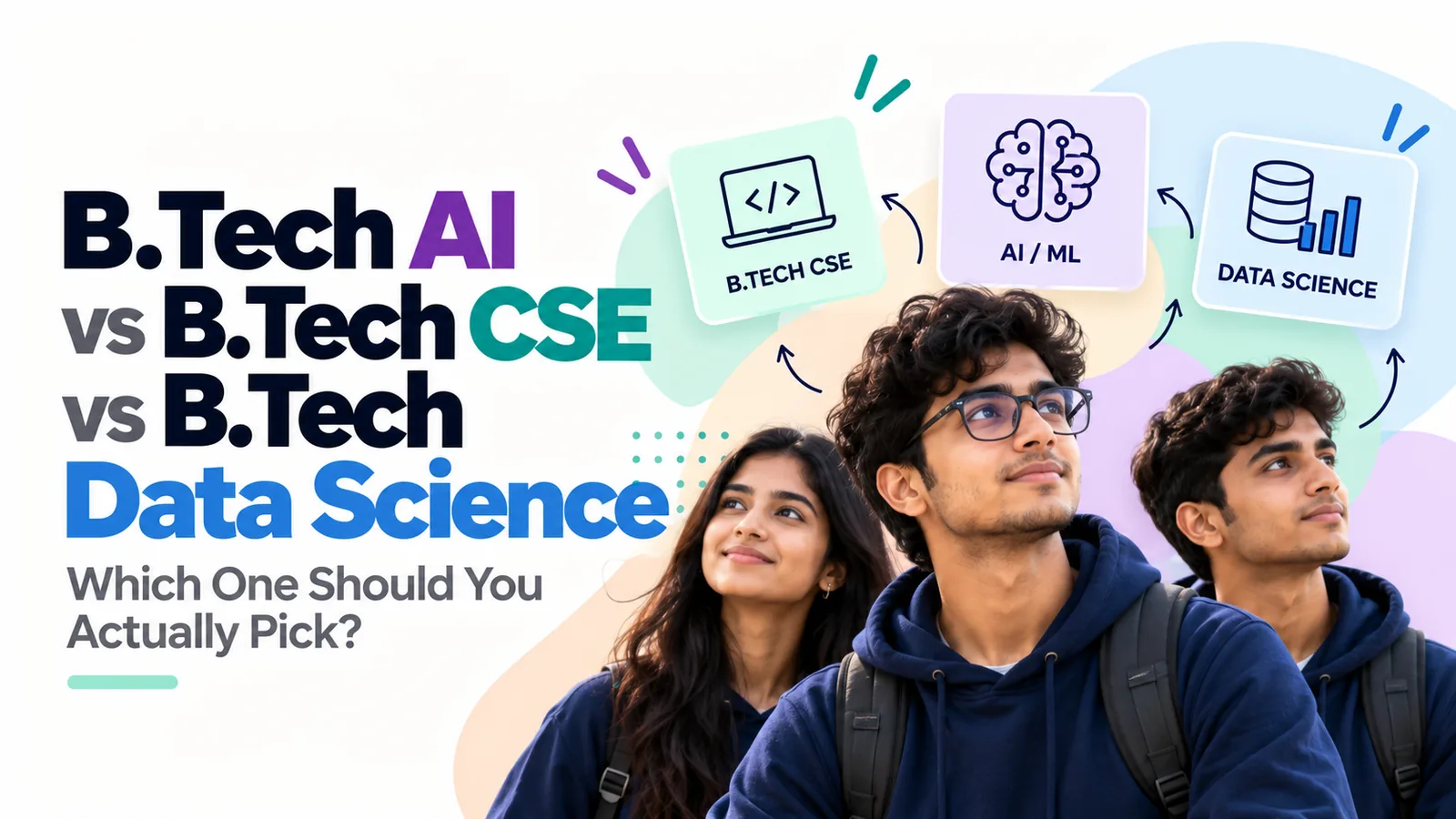
B.Tech AI vs B.Tech CSE vs B.Tech Data Science: Which One Should You Actually Pick?
If you are in Class 12th and filling out B.Tech applications right now, there is one question probably keeping you up at night. Do you go with Computer Science Engineering, the branch that's been building India's software workforce for thirty years? Or do you bet on Artificial Intelligence and Data Science, the newer track everyone keeps calling "the future"?
It's a fair question. And it's an expensive one to get wrong; four years and a few lakh rupees are following this decision.
Here is the part that trips people up: a lot of colleges don't offer AI or Data Science as fully separate degrees. You will see them listed as B.Tech CSE Artificial Intelligence or B.Tech CSE Data Science, specialization tracks nested inside a core CSE degree, sitting next to standalone options like a full B.Tech in Data Science. This guide treats all of these as the real paths students are actually comparing, no matter how a college brands the certificate.
By the end of this, you will know which branch fits you better.
Quick Answer: Which One Should You Pick in 2027
No branch is universally better; the right one depends on what works for you.
-
Pick B.Tech AI if you already know you want to work on machine learning, generative AI, or AI products, and you want that to be the focus of your degree from year one rather than something you add later.
-
Pick CSE if you are not fully sure whether you want to build products, work on infrastructure, or move into management, and you want a safer, more general starting point instead.
-
Pick Data Science if you enjoy statistics and finding patterns in numbers more than you enjoy pure coding, and you're drawn to analytics, business intelligence, or research-adjacent roles.
What is B.Tech CSE?
Computer Science Engineering is the base layer of computing. Over four years, you learn the fundamentals every digital system runs on: programming languages, data structures and algorithms, operating systems, networks, databases, computer architecture, and software engineering.
You are not trained for one specific job; you are trained to be a general-purpose computing problem solver. That is why CSE graduates move into software development, cloud, cybersecurity, DevOps, and machine learning. How much AI a CSE degree includes depends heavily on the college. In a standard CSE syllabus, AI and ML are often one or two electives in the later years. In a B.Tech CSE with an AI specialization, they become a full track of courses on machine learning, deep learning, computer vision, and NLP, built on top of the core CSE subjects. Check the semester-wise syllabus to see which kind you are looking at.
What is B.Tech in AI?
This program starts with the same base every engineering student needs: programming, data structures, and systems, but is built entirely around one goal: training students to design systems that learn, reason, and make decisions instead of just executing fixed instructions. That's the direction computing is heading, and this branch is structured specifically for it.
Beyond core programming, students go deep into machine learning, deep learning, neural networks, computer vision, NLP, and reinforcement learning, subjects that barely feature in a general CSE syllabus and go far beyond what a Data Science program covers.
The math runs deeper than in most engineering branches. Linear algebra, probability, calculus, and optimization aren't one-semester requirements; they run across multiple years, getting more advanced each time, because every AI model depends on them. The goal is to understand models well enough to build, train, and improve them, not just to call them from a library.
Daily work reflects this too: building and training models, tuning architectures, working with GPUs and large-scale compute, and testing systems against real-world performance, a rhythm that's completely different from a typical CSE lab and well beyond a standard Data Science routine. This makes B.Tech AI the most advanced and specialized of the three; it carries the full foundation of CSE, absorbs the statistical grounding of Data Science, and then builds several additional layers of specialization on top, exactly where the industry is hiring fastest.
What is B.Tech In Data Science?
This program focuses on working with data that already exists, collecting it, cleaning it, analyzing it, and extracting insights using statistics, visualization, and standard ML tools. Students learn programming, databases, data wrangling, and enough statistics to interpret and model data effectively.
It's a practical, applied path, but the math stays functional rather than research-grade, and the program doesn't go as deep into building or optimizing learning systems from scratch; that's the layer B.Tech AI is built specifically around.
Side by Side: The Three Branches at a Glance
Here is a quick comparison of the three branches:
| What You're Comparing | B.Tech CSE | B.Tech AI | B.Tech Data Science |
|---|---|---|---|
| Core focus | General computing | Machine learning and AI systems | Statistics and data analysis |
| Math intensity | Moderate | High | High, statistics-heavy |
| Career breadth | Widest | Focused on AI and ML roles, plus core software roles | Focused on data and analytics roles |
| Best for | Students still deciding | Students who want to build ML, GenAI, or AI products | Students who prefer statistics to pure coding |
| Hiring trend | Steady demand across software roles | Fastest-growing skill demand in job postings | Strong demand, especially in analytics |
Why B.Tech AI Is the One Everyone's Talking About
If it feels like "AI" is suddenly printed on every brochure, that's not just marketing. A few real shifts are driving it.
Why the demand is real:
-
Companies across banking, retail, healthcare, and IT services have moved AI and GenAI systems into actual production, not just pilots, which means they now need engineers who can build and ship this on day one, not learn it on the job later.
-
AI and ML hiring on Naukri rose 25% year-on-year in June 2026, against just 6% growth for white-collar hiring overall, and a 3% fall in IT services hiring the same month.
-
The share of Indian job postings on Indeed that mention AI rose from 8.2% in September 2024 to about 14% in January 2026, according to Indeed and Nasscom's 2026 AI talent report, with AI mentions most common in data and analytics and software development postings.
What Each Degree Actually Trains You to Do
The three branches share a first year and split hard by the third. Here's what each one is really built around.
B.Tech Artificial Intelligence
An AI degree keeps every CSE fundamental (data structures, operating systems, networks, databases) and pairs it with the statistics and math load a Data Science degree runs on (probability, inferential statistics, data mining). Nothing from either gets dropped. But it doesn't stop at combining the two; it rebuilds the curriculum around machine learning, deep learning, and increasingly, large language model engineering, from semester one instead of semester six, and takes those models all the way to deployment, something a pure Data Science syllabus rarely covers in depth.
On top of that, it goes into territory neither CSE nor Data Science touch on their own: computer vision, NLP, reinforcement learning, MLOps, and building the distributed systems that actually train and serve these models at scale, the engineering layer that turns a model in a notebook into a product people use. Some programs also add a business layer. Zenith School of AI's B.Tech AI program in Gurugram, for example, pairs the engineering track with an integrated Mini MBA, on the idea that AI engineers who also understand product and unit economics are worth more to startups than engineers who only know the math.
B.Tech Computer Science Engineering (CSE)
CSE is the generalist path. You study how computers work at every layer: hardware, operating systems, compilers, networks, databases, and software engineering. Machine learning usually shows up as an elective in year three or four, not the spine of the degree. The upside is flexibility; a CSE graduate can pivot into backend engineering, DevOps, cybersecurity, or machine learning without unlearning anything.
This is also where the most confusing labels live: B.Tech CSE Artificial Intelligence and B.Tech CSE Data Science. Both stay rooted in the core CSE syllabus, with an AI or data track added from year two or three. That's a meaningfully different structure from a standalone AI or Data Science degree, which is built around those subjects from semester one.
B.Tech in Data Science
A B.Tech in Data Science sits closer to statistics than software engineering. Expect heavier coursework in probability, inferential statistics, data mining, visualization, and experimental design, alongside Python and R. Machine learning is present, but framed as a tool for pulling insight from data, not a system you deploy at scale.
A simple way to remember it: CSE is the broadest, AI is the most specialized, and Data Science is the most statistics-heavy. All three overlap in the middle, which is exactly why the comparison feels confusing from the outside.
B.Tech CSE vs AI and ML: What Most Students Get Wrong
Here's something that clears up a lot of the confusion once you get it:
AI and Machine Learning aren't disconnected from computer science; they are built on it. But that doesn't mean AI is just a CSE add-on. A well-built AI program teaches the same data structures, algorithms, and programming fundamentals that CSE does, just applied to AI problems from semester one instead of parked as generic theory for three years.
That changes the actual comparison. A CSE graduate who wants to move into AI later usually needs a few extra semesters of deep learning, advanced math, and hands-on model-building before they're equally job-ready, often picked up through electives, self-study, or a master's. An AI degree builds that depth into the four years instead.
So the real question isn't "CSE or AI?" It's: do you want to specialise in AI from day one and skip the catch-up phase, or would you rather build a broad CSE foundation first and add AI depth later, if and when you decide you need it?
Both routes can work, and plenty of people succeed either way, especially if the college you pick has a curriculum that lets you branch out (worth checking before you commit, by the way). But one of them gets you to AI-specific job readiness faster, and right now, speed to specialisation is worth something real.
Which Degree Demands the Most Math?
This is the factor students underestimate the most. Here is a rough ranking of quantitative intensity, based on how much of the credit load goes toward math and statistics rather than pure programming.
-
AI: Heaviest overall load. It pulls in everything Data Science needs: linear algebra and probability run as core subjects because they underpin every ML and deep learning course, and still expects CSE-level programming depth on top of that.
-
Data Science: Heaviest pure math load. Expect calculus, linear algebra, probability, and inferential statistics to run across multiple semesters, not just year one.
-
CSE: Lightest of the three, though still substantial. Discrete math and basic probability cover you for most core CS subjects, and deeper statistics is optional unless you pick an AI/ML elective track.
If you disliked math in Class 11th and 12th and were hoping an engineering degree would let you avoid it, CSE is the more forgiving option of the three. If you actively enjoy statistics and probability, Data Science and AI will feel less like a grind and more like an extension of what you already liked.
Placement and Salary Reality Check in 2027
Salary comparisons between these three branches get exaggerated a lot online. The honest picture is that there isn't yet reliable branch-wise salary data for B.Tech AI as a standalone degree, because most standalone AI programs in India are too new to have several graduating batches behind them. What the hiring data does show is that demand for AI skills is rising faster than overall hiring, and that what you can build matters more to recruiters than what your degree is called.
A few honest observations about what actually moves the number:
-
The college tier moves the number more than the branch name does. A CSE graduate from a top-tier institute regularly out-earns an AI or Data Science graduate from a weaker one. The branch label is not doing as much work as students assume.
-
AI and Data Science currently carry a specialization premium, but only when backed by real project work. A student with a shipped ML pipeline or a deployed model usually stands out to recruiters more than a student with the same degree and no visible project work.
-
Company type matters more than city. Product companies and well-funded startups pay meaningfully more than IT services firms, regardless of which of the three branches you studied.
-
AI-specific skills such as LLM fine-tuning, RAG systems, and agent frameworks are among the most requested in current job postings, which is part of why AI-first programs have leaned so heavily into this content.
Fee Comparison Across the Three Paths
Fees vary by institute far more than they vary by branch, but a few patterns hold across the market right now.
-
Government institutes (NITs, IIITs, state universities): For NITs and state universities, fees are usually branch-agnostic, and the total four-year cost typically lands between ₹1.5 lakh and ₹9 lakh. Some IIITs cost significantly more: at IIIT Hyderabad, B.Tech tuition alone is ₹4.5 lakh a year, or about ₹18 lakh over four years.
-
Established private universities: CSE is often priced slightly lower than newer AI or Data Science specializations, since CSE programs have existed longer and compete on volume. Expect ₹5 lakh to ₹18 lakh for the full program across all three branches.
-
AI-first, industry-built programs: These tend to sit at the premium end, since the pitch is a purpose-built curriculum, current faculty, and heavier internship infrastructure rather than a repurposed CSE syllabus. Zenith School of AI's four-year B.Tech AI program, for example, runs ₹4.75 lakh per year (₹19,00,000 total), with scholarships available that can bring the effective cost down substantially for strong candidates.
The fee gap between branches at the same college is usually small. The fee gap between college tiers is usually enormous. Do not let a ₹2 lakh difference between CSE and AI at the same institute drive your decision; let the actual curriculum quality and placement outcomes drive it instead.
CSE, AI, or Data Science: Match Yourself to the Right Branch
Skip the brochures. Match yourself against these profiles instead.
CSE fits you if:
- You like building things end-to-end (apps, websites, systems), not just models.
- You want the widest range of job options after graduation.
- You're fine adding AI or data skills later, through electives, certifications, or a master's.
AI fits you if:
- You already know you want to work in machine learning, generative AI, or AI products.
- You'd rather go deep on fewer subjects than spread wide across general CS topics.
- You want to build and ship things, not just model data in a notebook.
- You like the idea of a business or product layer alongside the engineering, if your program offers one.
If that's you, it's the exact profile Zenith School of AI built its B.Tech AI program for: an engineering track paired with an integrated Mini MBA, so you graduate able to build the product and pitch it.
Data Science fits you if:
- Statistics and probability genuinely interest you, not just as a requirement.
- You're more drawn to "what does this data mean" than "how do I deploy this system."
- You see yourself in analytics, business intelligence, or research roles rather than pure software engineering.
- You're comfortable with a heavier math load across all four years.
How CSE, AI, and Data Science Careers Unfold
Starting job titles differ sharply across the three branches. By year five, they start to overlap, but where you begin depends heavily on what you studied.
First roles after CSE:
- Software Development Engineer
- Backend or Full Stack Developer
- Cloud or DevOps Engineer
- QA or Systems Engineer
First roles after AI:
- AI Engineer or Machine Learning Engineer
- NLP Engineer or Computer Vision Engineer
- MLOps Engineer
First roles after Data Science:
- Data Scientist or Data Analyst
- Business Intelligence Analyst
- Research or Quantitative Analyst
- Data Engineer
By year five, a strong performer from any of the three can move into ML engineering, technical product management, or a senior data role. The branch decides how fast you get in the door for a specific role. It doesn't lock you out of the others.
Internship and Industry Exposure: How The Three Compare
This is the part that gets the least attention in brochures and matters the most in real placement outcomes. Classroom subjects teach theory. Internships and live projects are what actually build a portfolio a recruiter trusts.
CSE programs typically treat internships as a summer activity between year three and four, arranged individually or through a general placement cell. Quality depends on how proactive you are about applying early.
Traditional Data Science programs usually follow the same pattern: one optional internship in the pre-final year, with exposure depending heavily on which company you land.
Newer AI-first programs have moved toward mandatory, structured exposure built into the semester calendar. Zenith School of AI's program, for example, builds in paid internships from year one and four mandatory externships with industry partners, alongside a full internship-length semester in year three.
Common Mistakes Students Make When Choosing
Choosing the trendiest name without checking the syllabus
Some colleges add "AI" to a CSE program that has only two or three AI electives. Before you apply, open the semester-wise curriculum and check how many courses are actually about machine learning, deep learning, and AI systems, and in which year they start.
Ignoring how comfortable you are with math
AI and Data Science both carry a heavy math and statistics load across all four years. If probability and linear algebra were a struggle in Class 11 and 12, be honest with yourself about that. CSE is the more forgiving option, and you can still move toward AI later through electives and projects.
Getting hypnotized by one huge placement number
A single outlier package says little about what most students earn. Ask every college for the median package, the share of the batch that was placed, and the list of recruiters, broken down by branch.
Thinking your branch name locks you in forever
It doesn't. CSE, AI, and Data Science graduates all move into ML, product, and data roles later in their careers. Your branch decides where you start and how much catching up you will do, not where you can end up.
Where Zenith School of AI Fits Into This Decision
If the comparison above has you leaning toward the AI path specifically, Zenith School of AI in Gurugram is worth a closer look. Its B.Tech in AI pairs a curriculum developed with input from AI researchers working in industry with an integrated Mini MBA, so you graduate with both the engineering depth and the product and business grounding this guide talks about.
The degree is awarded by K.R. Mangalam University, a NAAC A-Grade institution, and the program runs paid internships from year one alongside four mandatory externships, the exact kind of structured industry exposure this article recommends checking for before you commit four years to any branch.
FAQs
An AI degree usually gets you there faster, since ML and deep learning are core from year one. A CSE degree with a genuine AI/ML specialization track can reach a similar place with a broader base.
Not harder overall, but heavier on math and statistics specifically. It will feel natural if you enjoyed probability and stats in Class 12th, tougher if you did not.
No branch has a consistently better record across all colleges, and standalone B.Tech AI programs are too new at most colleges to have a long placement history. The college and your own project work move the outcome more than the branch name. Ask each college for branch-wise placement reports with the median package and the percentage of students placed.
Yes. A B.Tech AI covers ML, deep learning, and dataset work as core subjects, so you can aim for AI roles straight after graduation without extra coursework. Your projects still decide how ready you are.
It depends on what the extra fee buys. Compare the curriculum, the faculty, how internships are built into the program, and the total four-year cost after scholarships, side by side. A higher fee is worth it if you get more AI depth and more real industry exposure than a CSE program with an AI specialization would give you. If you don't, it isn't.
Less than students expect. For AI and ML roles, recruiters look first at your skills and your project work. A degree in AI signals focus and can help you get noticed, but a CSE graduate with strong ML projects will be considered for the same roles.
No. Lower competition usually just reflects lower current demand for that branch, not a hidden advantage worth chasing.
Not quite, though they overlap heavily in years one and two. CSE leans theoretical and development-focused; IT leans toward applied systems and networking.
Related reading: B.Tech in Artificial Intelligence: The Complete 2027 Guide
Disclaimer: B.Tech degree is awarded by K.R. Mangalam University. NAAC A Grade, UGC Recognized. All rights reserved by Nexus Global Intelligence and Education Pvt. Ltd. This blog is for general educational purposes only. Please verify program details, eligibility, and admission information on the official website before making any decision.