Data Science vs. AI Engineering: Which Career Should You Pick?
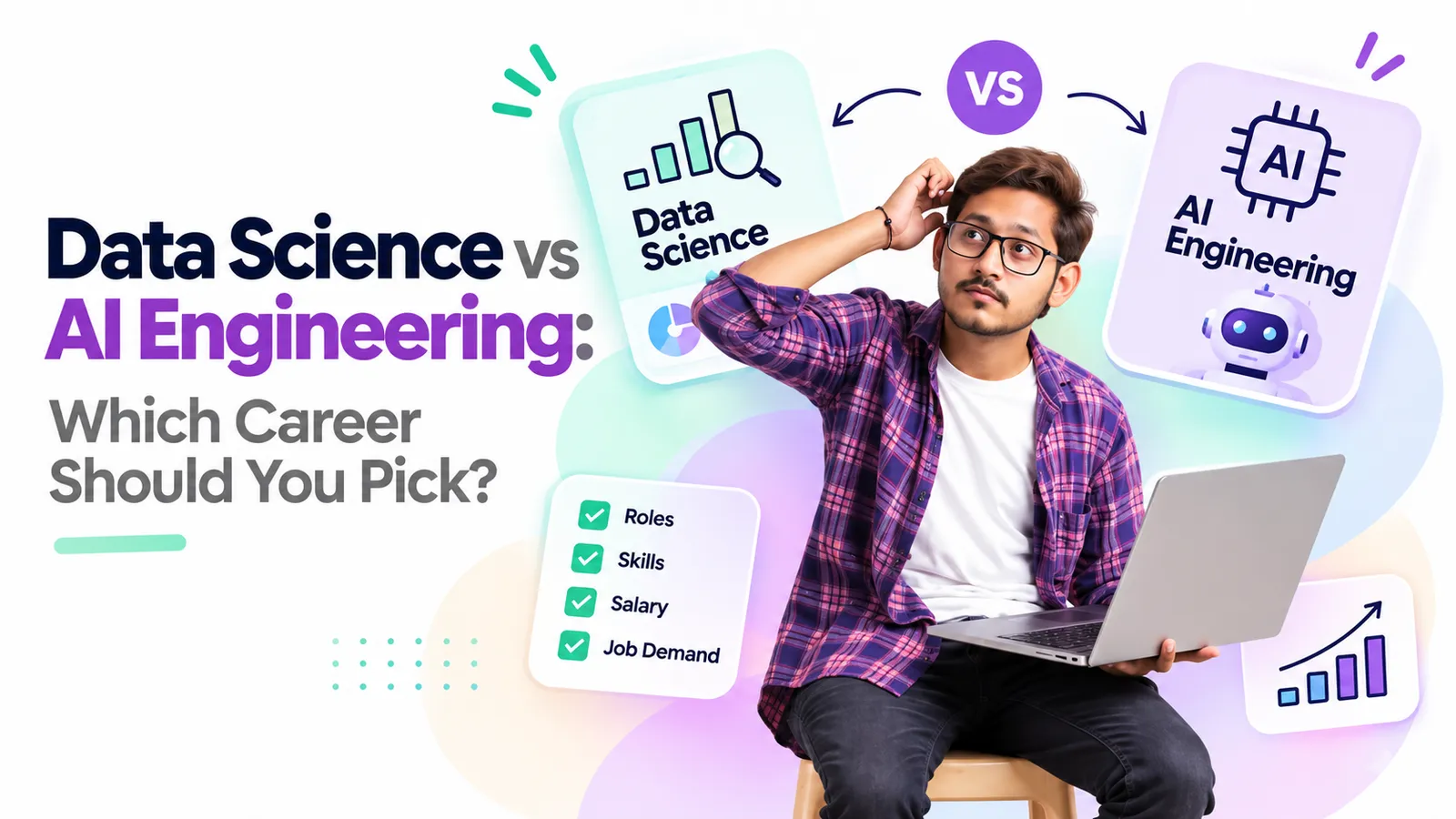
You're in Class 11 or 12, B.Tech applications are just around the corner, and you're thinking about your career. Data science and AI engineering are two fields you may have come across, but how do you know which one is right for you?
The data science vs. AI choice can be confusing, especially since the two fields overlap. However, the work, skills, and career opportunities differ. Let's look at both of them in detail to help you figure out where your interests lie.
What Does a Data Scientist Do?
A data scientist turns raw data into answers. Imagine a food delivery app asking, "Why do orders drop on Tuesdays?" A data scientist digs into the numbers, finds patterns, and tells the business what to do.
Their toolkit usually includes Python, SQL, statistics, and visualization tools like Tableau or Power BI. The job is part math, part storytelling. Harvard Business Review called it the "sexiest job of the 21st century" back in 2012, and the Future of Jobs Report 2025 lists big data and AI specialists among the fastest-growing roles through 2030.
What Does an AI Engineer Do?
An AI engineer builds intelligent products that work in the real world, such as chatbots, voice assistants, or features that recognize objects in photos. They turn models into reliable software thousands can use.
Their toolkit usually includes Python, deep learning frameworks like PyTorch and TensorFlow, APIs, and cloud deployment. Both roles involve coding, but AI engineers spend most of their time building and deploying AI-powered applications.
Data Scientist vs. AI Engineer: Key Differences
Here is how the data scientist vs. AI engineer roles compare:
| Parameter | Data Scientist | AI Engineer |
|---|---|---|
| Main goal | Find insights and guide decisions | Build and ship AI-powered products |
| Core skills | Statistics, SQL, analysis | Programming, deep learning, deployment |
| Typical output | Reports, dashboards, predictive models | Apps, APIs, working AI systems |
| Works closely with | Business and product teams | Software and engineering teams |
Simply put, a data scientist asks, "What is the data telling us?" while an AI engineer asks, "How do we build something smart with it?"
Data Science vs. Machine Learning: Where Does It Fit?
Students often confuse data science vs. machine learning:
- Data Science: A broader field focused on collecting, cleaning, and analyzing data to support business decisions.
- Machine Learning: A subset of AI in which systems learn patterns from data to make predictions without explicit, hard-coded instructions.
For example, a data scientist might use machine learning to predict customer churn, but also prepare data and present findings. AI engineers use machine learning too.
AI vs. Data Science Salary in India
Salary depends on experience, skills, and employer. Here's how earnings compare in India:
| Experience | Data Scientist | AI Engineer |
|---|---|---|
| 1–3 years | ₹11.3–12.5 LPA | ₹10.4–11.5 LPA |
| 3–6 years | ₹15–16.6 LPA | ₹15.3–16.9 LPA |
Source: AmbitionBox salary data for data scientists and AI engineers, last checked in November 2026.
With experience, both paths can cross ₹20 LPA. AmbitionBox's ranges are wide within each role, so pay depends less on the title than on your projects and the problems you can solve. For a fuller breakdown by experience, city, and employer, see our guide to the AI engineer salary in India.
B.Tech Data Science vs. B.Tech AI: What Should You Choose?
When comparing B.Tech Data Science vs. B.Tech AI, look beyond the degree title to the subjects you'll study:
- B.Tech in Data Science: Statistics, databases, analytics, and visualization, with some scope in ML.
- B.Tech in AI: Machine learning, neural networks, computer vision, and language models in greater depth, along with strong programming.
An AI degree usually covers data fundamentals too, leaving room to explore, while a data science degree may not go as deep into building AI systems. When researching an AI college in India, compare the curriculum, practical projects, and internship opportunities before deciding. Our B.Tech AI vs CSE vs Data Science comparison puts the three side by side in more detail.
Which Is Better, AI or Data Science?
If you're still weighing which is better, AI or data science, think about the problems you'd enjoy solving:
- Choose data science if you'd rather investigate why sales dropped or which trends a business should act on.
- Choose AI engineering if you'd rather build software, train models, and create tools like chatbots or image recognition systems.
Still unsure? Neither choice closes the door on the other. A data scientist can move into AI engineering by learning deep learning, software engineering, and model deployment, and strong programming, math, and data structures let you explore both.
How to Get Started with Data Science and AI in Class 12
You don't need your career mapped out yet, but you can start exploring:
- Learn Python basics through beginner-friendly courses.
- Revisit probability and statistics in your math syllabus.
- Try a small project, such as predicting cricket match scores with public Kaggle datasets and pandas or scikit-learn.
Final Thoughts
You don't have to decide overnight. A small project can show you which work interests you more. When shortlisting colleges, look for hands-on projects and industry exposure.
If AI engineering appeals to you, Zenith School of AI, an AI school in India, offers a B.Tech in AI with first-year internships and externships, global immersions, and a Mini MBA. Contact the admissions team at +91 92666 12266 or admissions@zenithschool.ai to learn more.
FAQs
Both fields offer good opportunities for freshers. Data science roles often suit graduates with strong analytical skills, while AI roles look for good coding skills and hands-on project experience. Your skills and portfolio can matter more than your job title.
A basic understanding of math helps, particularly statistics, probability, and linear algebra. You don't need to be a topper.
Physics, Chemistry, and Mathematics (PCM) is the most common combination for B.Tech. AICTE allows other combinations, but JEE Main still requires Physics and Maths. Computer Science helps, but you can learn Python separately.
Neither degree is automatically better. A B.Tech in AI is a good fit if you want to build intelligent systems, while Data Science suits students interested in analytics and working with data.
Related reading: How to Become an AI Engineer After 12th: Step-by-Step Roadmap
Disclaimer: B.Tech degree is awarded by K.R. Mangalam University. NAAC A Grade, UGC Recognized. All rights reserved by Nexus Global Intelligence and Education Pvt. Ltd. This blog is for general educational purposes only. Please verify program details, eligibility, and admission information on the official website before making any decision.