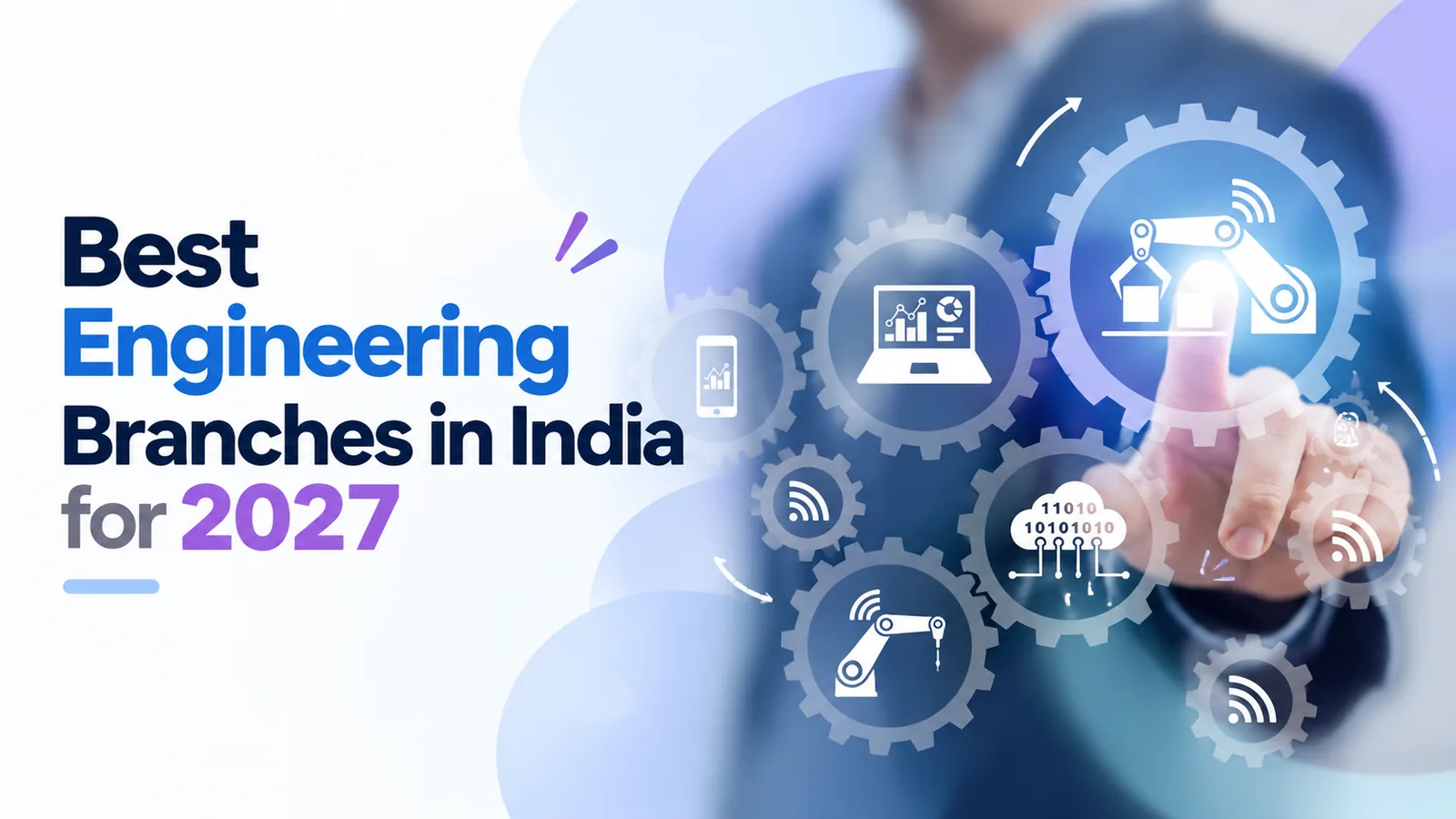
Best Engineering Branches in India for 2027
If you're in Class 11 or 12, chances are you've already heard plenty of advice about which engineering branch to choose. Your relatives have their favorites, your friends have their plans, and every YouTube video seems to recommend something different every day.
So, which engineering branch is best for you? The best engineering branch in India isn't necessarily the one everyone is talking about. Rather, it's the one that matches your interests, strengths, and career goals. Let's look at the top options for 2027 and what each has to offer.
Most In-Demand Engineering Branches
Hiring trends change, and demand differs by sector and location. The Indeed-NASSCOM Future of Work 2024 report identifies data scientist/analyst, AI/ML expert, cybersecurity specialist, cloud architect/engineer, and DevOps engineer among the most in-demand job roles. These roles map particularly closely to computer science, IT, AI and Data Science, and cybersecurity pathways.
Other branches also lead to opportunities in areas such as semiconductor design, power systems, manufacturing, and infrastructure. The sections below explain what you study in each branch, the roles it can lead to, and where demand is developing.
Top Engineering Branches With High Salary
The top engineering branches with high salary potential often include CSE and AI and Data Science. ECE can also pay well in specialized areas such as chip design. However, earning potential ultimately depends on the role, your technical skills, and your experience.
The table below gives indicative salary ranges for related roles in India:
| Branch | Common Entry-Level Role | Typical Entry-Level Salary (in INR) |
|---|---|---|
| CSE | Software Engineering Trainee | ₹1.8–7 LPA |
| AI and Data Science | Artificial Intelligence Engineer | ₹8.8–10.1 LPA |
| ECE | Electronics Engineer Trainee | ₹1–5 LPA |
| Electrical | Electrical Engineer | ₹1.2–5.4 LPA |
| Mechanical | Mechanical Graduate Engineer Trainee | ₹1.8–8.5 LPA |
| Civil | Civil Graduate Engineer Trainee | ₹2–8.5 LPA |
Source: AmbitionBox, entry-level (0–1 years) salary data, checked October 2026
For additional context, Zenith School of AI highlights an average package of ₹16 LPA+ and a highest package of ₹2.7 crore among outcomes associated with Programming Pathshala. Salary figures can vary by role, experience, and employer, so consider them alongside the skills and career opportunities each engineering branch offers.
Best Engineering Branch for Placements
If getting a job soon after graduation is your top priority, start with CSE and IT. Software companies and startups hire plenty of graduates from these two branches. Mechanical and civil engineering can also offer good opportunities, though campus hiring may differ from college to college.
Don't pick a branch based on placement claims alone. Ask the college for its latest placement report and check how many students were placed, what the median salary was, and which companies hired them. Ask about internships, too. A college where students work on real projects and gain industry experience may give you a better start when you enter the job market.
Top Engineering Branches in India: Branch-by-Branch Breakdown
Each engineering branch covers different subjects and career paths. Check the university syllabus before applying, as course structures vary:
Computer Science Engineering (CSE)
You study programming, data structures, algorithms, operating systems, databases, and software design. Common roles include software engineer, backend developer, cloud engineer, and cybersecurity analyst. Demand is rising across software products, cloud infrastructure, enterprise technology, and security.
Artificial Intelligence, Machine Learning, and Data Science
You study programming, statistics, linear algebra, data handling, machine learning, and AI systems. Graduates may work as AI/ML engineers, data scientists, data analysts, or machine learning engineers. AI adoption is creating opportunities, although entry-level roles often require strong fundamentals and practical project experience.
Information Technology (IT)
IT focuses on software, networks, databases, cloud services, and information systems. Typical roles include IT engineer, systems administrator, cloud support engineer, and software developer. Cloud migration, platform engineering, data security, and digital services are relevant areas to watch.
Electronics and Communication Engineering (ECE)
You study circuits, signals, communication systems, embedded systems, and digital electronics. Roles include electronics engineer, embedded systems engineer, hardware validation engineer, and semiconductor design engineer. Semiconductor manufacturing, chip design, telecom, and connected devices are important areas of opportunity.
Electrical Engineering
Electrical Engineering covers electrical machines, power systems, control systems, and power electronics. After graduation, you could work as an electrical design engineer, power systems engineer, or EV systems engineer. Renewable energy, battery technology, electric vehicles, and grid modernization are worth exploring.
Mechanical Engineering
In Mechanical Engineering, you learn about mechanics, materials, thermodynamics, manufacturing, CAD, and machine design. Career options include mechanical design engineer, manufacturing engineer, quality engineer, and robotics engineer. You can find opportunities in the automotive industry, manufacturing, industrial automation, and robotics.
Civil Engineering
Civil Engineering focuses on structural design, construction materials, soil mechanics, transportation, and water resources. Graduates often work as site engineers, structural design engineers, planning engineers, or quantity surveyors. These skills are used in infrastructure projects, road and rail networks, urban development, and water management.
Chemical Engineering
Chemical Engineering teaches you how to design and manage processes that turn raw materials into useful products. The course covers thermodynamics, reaction engineering, process control, and plant design. You could work as a process engineer, production engineer, or quality and safety engineer in industries such as chemicals, pharmaceuticals, food processing, and energy.
Aerospace Engineering
Aerospace programs cover aerodynamics, propulsion, flight mechanics, structures, and control systems. Graduates may pursue roles in aircraft design, testing, maintenance engineering, or propulsion. Demand is linked to aerospace manufacturing, defense, aviation, and research, and specialized roles may require further study.
Biotechnology Engineering
You study biology alongside engineering, including genetics, microbiology, bioprocessing, and laboratory methods. Possible roles include bioprocess engineer, research associate, quality-control analyst, and biotechnology production associate. Relevant areas include biotechnology, pharmaceuticals, diagnostics, and industrial biomanufacturing.
Robotics and Mechatronics
These interdisciplinary fields combine mechanical systems, electronics, control engineering, and programming. Typical roles include robotics engineer, automation engineer, controls engineer, and embedded systems engineer. Industrial automation, smart manufacturing, logistics, and autonomous systems are areas to watch.
Renewable Energy Engineering
You study energy systems, solar and wind technologies, storage, power electronics, and energy efficiency. Roles include renewable energy engineer, solar design engineer, energy analyst, and project engineer. India's energy transition and grid integration work are relevant growth areas.
Future Scope of Engineering Branches
Government initiatives can offer a useful clue about which technical fields India is investing in. The IndiaAI Mission, approved in March 2024, received ₹10,371.92 crore to support AI computing infrastructure, skills development, research, and startups. India is also investing in semiconductor manufacturing, and its energy goals include reaching 500 GW of installed non-fossil fuel power capacity by 2030.
So the future scope of engineering branches looks strong in AI, semiconductors, and renewable energy. If you are looking for the best engineering branches for the future, watch these three areas closely. They also overlap, since AI is now used in chip design and energy grids.
How to Choose the Best B.Tech Branch in 2027?
Start with what you actually enjoy, then check which fields have steady hiring. Use these pointers to shortlist a B.Tech branch:
-
CSE: You enjoy coding, solving logic problems, or building apps.
-
AI or AI and Data Science: You're curious about how chatbots work or how computers learn from data.
-
IT: You're interested in software systems, networks, databases, or cloud services.
-
ECE: You like understanding circuits, chips, and how electronic devices work.
-
Electrical Engineering: You're interested in EVs, power systems, or renewable energy.
-
Mechanical or Robotics: You'd rather design machines, work with materials, or build automated systems.
-
Civil: You're interested in buildings, roads, transport, or infrastructure.
-
Chemical or Biotechnology: You're curious about industrial processes, materials, life sciences, or laboratory work.
If you enjoy coding but aren't sure about AI, CSE is a sensible place to begin.
Your college matters just as much as your choice of B.Tech branch. Two colleges may offer the same degree but teach very different skills. One may have well-equipped labs and plenty of hands-on projects, while another focuses mostly on theory. Before deciding, check the syllabus, lab facilities, internship opportunities, and industry exposure.
Finally, check entrance exams and cutoffs for your preferred colleges. JEE Main, state CETs, and university exams have different eligibility criteria and application dates.
Mistakes Students Make While Choosing an Engineering Branch
A branch that works for your friend may not suit you. Watch out for these common mistakes:
-
Choosing the same branch as a friend or a topper without considering your own interests.
-
Following last year's trends without looking at current career opportunities.
-
Assuming a degree alone will get you a job, without building practical skills.
-
Applying to a college without checking its syllabus, lab facilities, or internship opportunities.
Don't let popularity dictate your decision. The best engineering branch in India is the one that prepares you for the career you want and keeps you curious for all four years.
Where Zenith School of AI Fits In
If you're leaning toward AI, look beyond the course title and check what you'll actually learn. Zenith School of AI, launched in 2026, offers a B.Tech in AI with internships and externships from the first year, global immersions, and a Mini MBA. The degree is awarded by K.R. Mangalam University, which is NAAC A Grade accredited and UGC-recognized.
Explore the curriculum at Zenith School of AI and see how the program compares with other colleges on your shortlist. For questions about eligibility or course details, call +91 92666 12266 or email admissions@zenithschool.ai to speak with the admissions team.
FAQs
For most students who enjoy coding, CSE and AI and Data Science offer the widest range of roles and the strongest hiring demand in 2027. ECE is a strong choice if you are drawn to chips and electronics, and Electrical Engineering if you are interested in EVs and renewable energy. The best branch for you is the one in that list that matches what you enjoy studying.
Yes. Mechanical engineers work in areas such as automobile design, manufacturing, and robotics. Learning tools like CAD software or automation can open up more job opportunities.
Some colleges allow students to switch branches after the first year, depending on their grades and available seats. Others don't. Check your college's rules before taking admission.
Both matter. A good college can offer better teaching, practical projects, and internships, but your branch determines what you study. Look at both before making your choice.
Yes, if you enjoy math, coding, and problem-solving. AI roles are growing as more companies adopt AI tools, and the IndiaAI Mission is backing the field with funding for computing, skills, and startups. Just check that the program teaches core programming and machine learning basics, not only trending tools.
Related reading: B.Tech AI vs B.Tech CSE vs B.Tech Data Science: Which One Should You Actually Pick?
Disclaimer: B.Tech degree is awarded by K.R. Mangalam University. NAAC A Grade, UGC Recognized. All rights reserved by Nexus Global Intelligence and Education Pvt. Ltd. This blog is for general educational purposes only. Please verify program details, eligibility, and admission information on the official website before making any decision.