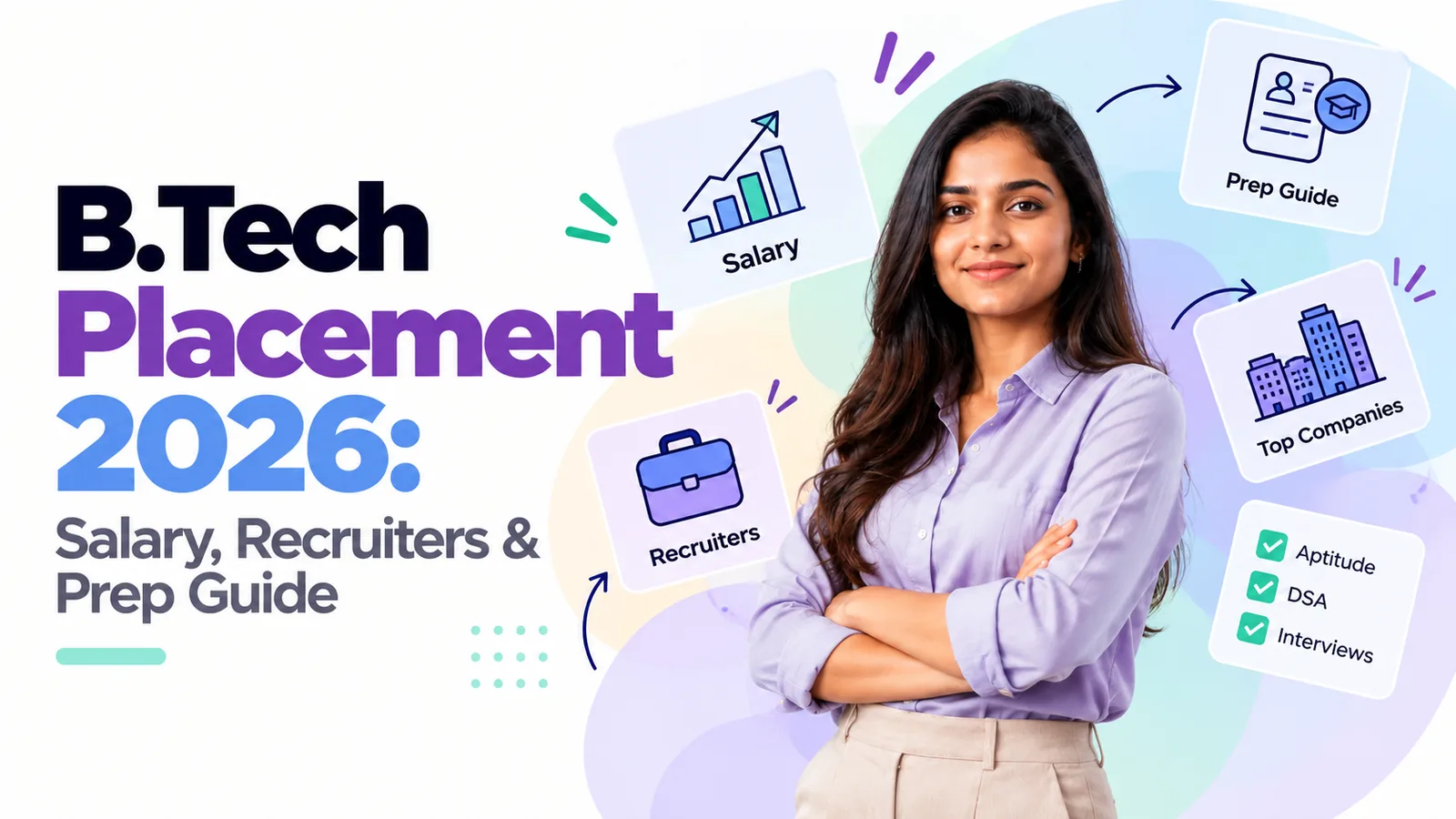
B.Tech Placement 2026: Salary, Recruiters & Prep Guide
Ever wondered why some B.Tech graduates land jobs confidently while others struggle? It is rarely about marks alone. Recruiters increasingly look beyond textbooks, valuing projects, real-world problem-solving, internships and adaptability, especially as AI reshapes engineering hiring.
Your branch, technical skills, practical experience and interview readiness all influence the opportunities available to you. This guide explains how B.Tech placements actually work, realistic salary expectations, which companies are hiring, and how to prepare early for a stronger offer.
Eligibility Criteria for B.Tech Placements
Before you even sit for a company interview, most colleges filter students based on a set of eligibility rules. These vary slightly by institution, but the pattern is fairly consistent across India:
-
Minimum CGPA: Most companies ask for a CGPA between 6.0 and 7.0 out of 10, though premium recruiters like Google or Microsoft often push this closer to 7.5 or 8.0.
-
No active backlogs: Almost every major recruiter wants your backlogs cleared before the interview, sometimes before registration even opens.
-
Attendance requirement: Colleges often require a minimum attendance percentage (commonly 75%) to even register for placements, since it reflects on the institution during recruiter interactions.
-
Branch-specific eligibility: Some core companies only hire from specific branches. A company looking for AI engineers, for instance, is unlikely to interview a Mechanical Engineering student, even if that student applies, regardless of interest or effort.
-
Pre-placement training: Many universities make it mandatory to attend aptitude workshops, resume-building sessions, or mock interviews before you can sit for the actual drives.
If you are a first- or second-year student reading this, keep your CGPA and attendance in a healthy zone from the start. Cleaning up backlogs in your third year, right when placement prep should be your focus, adds pressure you don't need.
How a B.Tech Placement Drive Actually Works
A placement drive usually follows a fairly predictable sequence, although the exact rounds vary by company.
Pre-placement talk → Registration → Online assessment → Coding/technical assessment → Technical interview → HR or behavioural round → Offer
Here is what each stage typically involves:
1. Pre-placement Talk
The company introduces itself, explains the role, discusses eligibility, compensation structure and selection process. This is also your chance to understand whether the position actually matches your interests.
2. Registration and Shortlisting
Eligible students register for the drive. The college or company may shortlist candidates based on CGPA, branch, academic history or other criteria.
Some colleges also have internal placement policies that determine which students can participate in subsequent drives after accepting an offer.
3. Aptitude or Online Assessment
Mass recruiters commonly begin with an online assessment covering areas such as quantitative aptitude, logical reasoning, verbal ability and basic technical knowledge.
For software roles, this may also include programming questions.
4. Coding or Technical Assessment
Technology-focused recruiters may test data structures and algorithms, programming fundamentals, SQL, debugging or role-specific technical knowledge.
The difficulty can vary dramatically between companies. A service-based company may focus on programming fundamentals, while a product company may use multiple coding problems with stricter time limits.
5. Technical Interview
The interviewer may ask about your programming knowledge, core subjects, internships and projects. For AI or data-related roles, questions may extend to machine learning concepts, statistics, model selection and deployment.
Your projects matter here because interviewers can use them to understand whether you actually built what your resume claims.
6. HR or Behavioural Round
The final round may cover communication, teamwork, career goals, relocation, salary expectations and behavioural situations.
This round is less about technical knowledge and more about demonstrating that you can communicate clearly and work effectively in a professional environment.
On-campus, off-campus and pool-campus placements
On-campus placements happen through your university or college placement cell, usually with recruiters visiting the campus or conducting virtual drives.
Off-campus placements are applications you make directly through company career pages, referrals, job platforms or networking.
Pool-campus drives bring students from multiple colleges together for a shared recruitment process. These can increase access to recruiters beyond your own institution.
Placement policies also differ between colleges. Some institutions allow students to continue participating after receiving an offer, while others may restrict participation under a one-offer or dream-offer policy. Always check your college's current placement rules before accepting an offer or registering for another drive.
B.Tech Placement Packages and Recruiters: What to Actually Expect
This is the part everyone wants a straight answer to, so let's be direct. Package numbers are reported in LPA, which stands for Lakhs Per Annum. If someone tells you their package is "8 LPA," that means eight lakh rupees a year, before tax, and this figure often includes bonuses and benefits, not just your take-home cash.
B.Tech placement packages vary a lot depending on the company tier, your branch, your skills, and, to some extent, a bit of luck in timing.
Broadly, you can group recruiters into three buckets:
-
Mass recruiters (IT services companies): Think TCS, Infosys, Wipro, Cognizant, Capgemini. These firms hire in bulk, sometimes hundreds of students from one college in a single season.
-
Mid-tier product and service companies: This includes companies like LTIMindtree, Persistent Systems, smaller product startups, and mid-sized MNCs. The selection process is tougher, usually involving live coding rounds.
-
Product-based giants and global tech firms: Google, Microsoft, Amazon, Adobe, Cisco, Palo Alto Networks, and similar names fall here, along with high-growth Indian unicorns.
Your branch can significantly affect what you can expect; the next section breaks that down.
Top Recruiters for B.Tech Graduates
Recruiter requirements, compensation and selection processes change from year to year, so students should verify the latest role-specific information before treating any package range as a benchmark.
| Tier | Recruiters | Typical package | What They Test |
|---|---|---|---|
| Mass recruiters (IT services) | TCS, Infosys, Wipro, Cognizant, Capgemini, Accenture | 3.5–7 LPA | Aptitude, basic coding, communication |
| Mid-tier product and services | LTIMindtree, Persistent Systems, Zoho, mid-sized MNCs | 6–15 LPA | Live coding, DSA, technical interviews |
| Product-based and global tech | Google, Microsoft, Amazon, Adobe, Cisco, Salesforce | 18 LPA+ | DSA, technical depth, system design/project discussion |
| Core engineering | L&T, Tata Power, Ashok Leyland, Siemens, BHEL | 4–8 LPA | Domain fundamentals, technical knowledge/interviews |
Placement drives are not necessarily conducted in the same order at every college. However, students may encounter large-volume recruiters earlier in the placement season, followed by companies with more specialised or competitive requirements.
This can make early preparation particularly useful. A student may secure an initial offer while continuing to participate in drives permitted under the college's placement policy.
B.Tech Placement Trends by Branch
Your branch shapes your placement outcome more than most students realise going into first year. Here's how things actually play out.
B.Tech in Artificial Intelligence and Machine Learning
AI and ML skills are in high demand, and software job openings have crossed 14 lakh, with a growing share asking specifically for AI skills. A B.Tech in AI spends more of its four years on the math, models, and deployment skills these roles need. Placement rates for AI branches vary widely by college, so ask for branch-wise placement reports rather than relying on general claims.
Computer Science Engineering (CSE) and IT
CSE and IT continue to attract steady interest from mass recruiters, mid-tier product companies, and global tech firms, giving students a decent spread of opportunities. But within this pool, the trend is clear: recruiters are visibly shifting toward candidates with AI/ML exposure. Projects, internships, or electives in AI/ML tend to unlock a different tier of offers altogether.
Electronics and Communication Engineering (ECE)
ECE students have access to both core electronics opportunities and software roles.
Core opportunities may include semiconductor companies, embedded systems, telecommunications and electronics. Many ECE graduates also move into software because their degree provides a foundation in mathematics, programming and technical problem-solving.
Building additional skills in programming, embedded systems, VLSI, data or AI can help students align themselves with particular recruiter requirements.
Electrical and Electronics Engineering (EEE)
EEE offers opportunities across power, electronics, robotics, automation, and embedded systems. Some students secure solid core engineering roles, while others build specialised technical skills and access better-paying opportunities. However, compared with advanced fields such as AI, salary packages in EEE may generally be more moderate or lower.
Mechanical and Civil Engineering
Core companies like L&T, Ashok Leyland, Tata Power, and various infrastructure firms still hire steadily from these branches, though the average package tends to sit lower than CSE, often in the 4 to 8 LPA range. Students who add skills like AutoCAD, SAP, or data analysis on top of their core degree tend to stand out; these skills map directly to what core recruiters screen for.
Broad B.Tech vs AI-Focused B.Tech: What's Different
Traditional universities such as Chandigarh University, LPU and Amity offer broad B.Tech programmes alongside specialised technology tracks. Newer AI-focused programmes take a more specialised approach by making AI the central theme of the curriculum.
For students comparing options such as Chandigarh University B.Tech placement, the better question isn't simply which programme has the higher placement figure. It is how the programme's curriculum, industry exposure and specialisation match your career goals.
| What to compare | Broad B.Tech with specialisation | AI-focused B.Tech |
|---|---|---|
| Share of curriculum | AI subjects sit alongside a broader engineering and computing foundation | AI, mathematics, programming and related technologies receive greater curricular focus |
| Internships | Structure and requirements vary by university and programme | Some programmes make internships a formal part of the curriculum |
| Depth versus breadth | Broader foundation with flexibility across different technology or engineering areas | Greater specialisation in AI-related subjects, with less breadth by design |
| Who it suits | Students who want broader options or are still exploring their area of interest | Students who already want to build their career around AI and related technologies |
How To Prepare for B.Tech Placements
AI placements move faster than most other tech roles right now, but that also means the placement bar keeps rising. Below are the major steps every student should follow while preparing for B.Tech placements:
Cover the Fundamentals Every Recruiter Tests
Whatever your branch, the early stages of placement hiring often test quantitative aptitude, logical reasoning, verbal ability, and, for software-related roles, data structures and algorithms. Practising these areas under a time limit is important because placement tests are as much about speed and accuracy as they are about knowing the concepts. For core branches, the focus shifts to your domain fundamentals, with recruiters testing subjects directly related to your engineering syllabus.
Build Skills for AI Roles
If you are targeting AI roles, recruiters typically look for:
- Math that underpins AI: linear algebra, probability, statistics, and optimization
- Data structures and algorithms, still tested in coding rounds
- Theory plus hands-on ML and deep learning, not just running a library
- Computer vision and NLP, barely touched in short courses
- AI ethics and explainability
- MLOps and deployment, since production is a different skill from building
- Software engineering fundamentals, skipped by most bootcamps
Sharpen Communication Skills Early, Especially for AI Roles
AI interviews often include a part where you have to elaborate on a technical decision to someone non-technical, or defend why you picked one model over another. If you can't explain your own project clearly, that's a red flag, not a formatting issue.
Start practicing now. Explain your projects out loud to a friend outside your field. If they can follow along, you're in good shape. If they look lost, simplify further.
Compete, Don't Just Learn
Reading about Artificial Intelligence and Machine Learning and actually building something under a deadline are two very different experiences. Coding competitions, AI hackathons, and open-source contributions force you to debug real problems, work with messy data, and make decisions fast.
Build a Resume That Shows You Can Actually Build Things
For AI roles, your resume needs to prove you can do the work, not just that you have heard of it. Keep it updated with:
- Projects with real outcomes (accuracy scores, deployed apps, GitHub links, anything measurable)
- Internships, even short ones, especially if they involved real data
- Certifications, but only the ones that actually taught you something
- A GitHub profile that's active, not just a repo from your first semester
One well-documented end-to-end project (data collection to deployment) will impress recruiters more than five half-finished notebooks. Depth beats quantity here, every time.
Start building now, one real project at a time. That's genuinely what separates the students who get placed early from the ones still polishing their resume.
Where Does Zenith School of AI Fit Into This Picture?
Earlier, we mentioned that a newer wave of AI-first B.Tech programs is emerging alongside the big multi-course universities. Zenith School of AI is a useful example of what that looks like in practice, if AI specifically is the direction you are considering.
Zenith runs a 4-year residential B.Tech in Artificial Intelligence with a Mini-MBA built into the same degree, awarded by K.R. Mangalam University, a NAAC A-Grade, UGC-recognized university in Gurugram.
A few things stand out about how it's structured: the curriculum is refreshed every year with input from AI researchers working in industry, paid internships start from year one (up to ₹2 lakh a year, two mandatory before graduation), students complete four externships, drawn from a pool of over 30 industry partners, before placement season even begins, and admission runs through ZAPT, an aptitude-based test rather than a JEE rank cutoff.
Zenith launched in 2026, so its first batch has not yet been through a placement season. Ask the admissions team how internships and externships are structured, and what placement support is planned.
Final Thoughts
Placements are shaped by more than the college name alone. Your branch, technical skills, projects, internships, and preparation all influence the kind of opportunities you can access. Hence, starting early and building industry-relevant skills can give you a clear advantage when placement season arrives.
For students planning to build a career in AI, Zenith School of AI offers a focused AI curriculum from the first year, along with year-one paid internships and a Gurugram location. Explore the programme and check the latest admission details on the Zenith School of AI website.
FAQs
B.Tech placement packages vary with college, branch, skills and interview performance, but the tiers are fairly consistent. Mass recruiters in IT services typically start around 3.5 to 7 LPA and hire in large volumes. Mid-tier product and services companies generally sit between 6 and 15 LPA, while product-based and global tech firms start around 18 LPA and can go considerably higher for the strongest candidates. Individual universities publish their own placement reports each year, so check those for institution-specific figures rather than relying on averages quoted elsewhere.
Yes. Your branch plays a major role in what placement you're getting. However, technical skills, projects, internships, coding ability, and interview performance also play an important role in determining placement outcomes. Nowadays, the world is moving rapidly with AI, and companies across industries are looking for graduates who are more proficient in AI-based technologies.
It varies by college. CSE and AI branches generally see the most recruiters and the highest packages, but the gap depends on the college and on each student's skills. Ask for branch-wise placement reports, including the median package and the percentage placed.
Anything between 3.5 LPA and 6 LPA is a solid outcome from most private universities.
Both matter. A strong college brings more recruiters, and a specialized branch like AI brings sharper skill alignment on top of that, but individual effort still decides who lands the better offer.
Neither degree guarantees a placement outcome; it comes down to your skills, projects and interview performance. The difference is curriculum depth. A B.Tech in AI builds the maths, model theory and deployment skills across all four years, while CSE covers a broader computing base with AI as electives or a specialisation. If you already know you want to work in AI, the AI-first route gets you deeper into the specialism earlier. If you would rather keep software, systems and product roles open, CSE stays broader. Compare the actual curriculum, internship structure and industry exposure of the specific programmes you are considering rather than deciding on the branch name. For a detailed side-by-side, see our B.Tech AI vs CSE vs Data Science comparison.
Start building your technical foundation and a project direction from day one for cracking placements. The field moves fast, and staying current takes consistent effort.
Almost always, yes. Internships give you real project experience, a stronger resume, and sometimes a pre-placement offer from the same company.
Related reading: Best Engineering Branches in India for 2027
Disclaimer: B.Tech degree is awarded by K.R. Mangalam University. NAAC A Grade, UGC Recognized. All rights reserved by Nexus Global Intelligence and Education Pvt. Ltd. This blog is for general educational purposes only. Please verify program details, eligibility, and admission information on the official website before making any decision.