What Is an 'AI School'? How India's New-Age Colleges Are Reinventing Tech Education
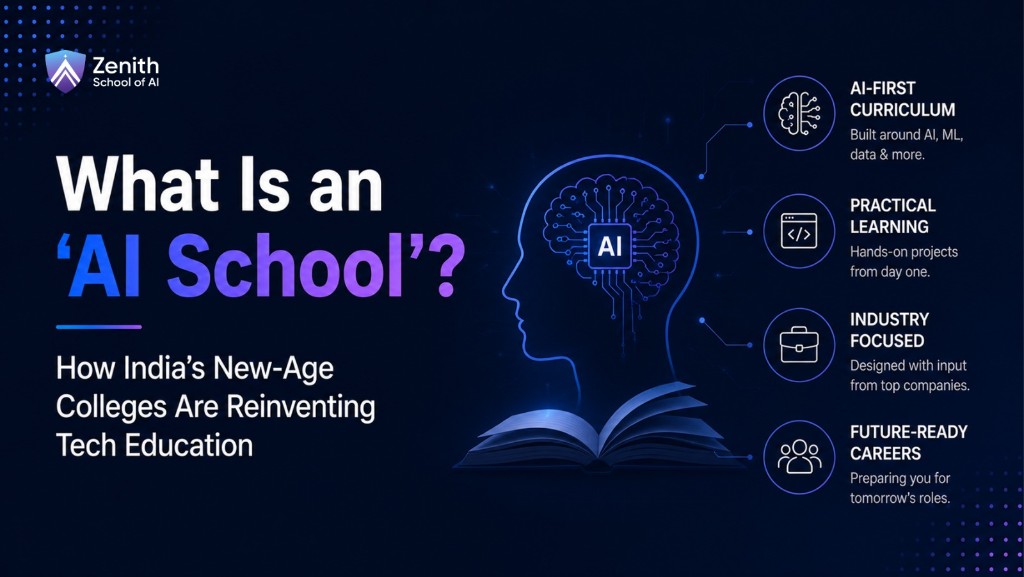
Quick answer: An AI school (or "school of AI") is a college that treats artificial intelligence as the core discipline of its curriculum rather than as a specialisation inside a computer-science degree. Students build with machine learning, large language models, and applied data from the first year. In India, this AI-first model is being pioneered by new-age institutions including Zenith School of AI, alongside CS-and-AI programmes from Scaler School of Technology and Newton School of Technology.
Key takeaways
- An AI school organises its entire curriculum around building AI systems, not around general computer science.
- The "school of X" naming — School of Technology, School of AI — signals a focused, industry-built programme distinct from a conventional university department.
- The shift is driven by AI tooling lowering the value of routine coding and raising the value of problem framing, system design, and AI judgement.
- The strongest AI schools pair this modern curriculum with a UGC-recognised degree from an accredited university.
Where the "AI school" came from
For decades, the default path into Indian tech was a four-year B.Tech in computer science or electronics, mostly lectures and exams, with project work bolted on at the end. Over the last few years, a different model emerged: privately run, industry-built programmes — often branded as a "School of Technology" or "School of AI" — that teach by building from day one.
The naming is deliberate. Calling something a school of AI rather than a computer science department signals a narrower, deeper focus: the institution is organised around producing people who can build and ship AI systems, not around covering the full breadth of a traditional engineering syllabus.
AI-first vs CS-with-AI: the core distinction
The difference between an AI school and a conventional programme with an AI track comes down to what sits at the centre.
| Traditional CS / CS-with-AI | AI-first school | |
|---|---|---|
| Centre of gravity | Computer science fundamentals; AI as a later specialisation | AI systems as the organising discipline from year one |
| First-year work | Foundational theory, broad coverage | Building with data, ML, and AI tooling early |
| What's optimised for | Breadth of engineering knowledge | Ability to frame problems and build/evaluate AI systems |
| Teaching style | Lecture- and exam-led | Project- and build-led |
Neither is universally "better." A traditional B.Tech gives broader engineering coverage; an AI-first school front-loads the exact skills AI-building careers reward. The right choice depends on whether you want to be a generalist engineer or an AI builder specifically.
Why this shift is happening now
Three forces are pushing the AI-first model:
- AI tooling is collapsing the cost of routine code. When an assistant can scaffold a function, the durable human skills become system design, problem framing, evaluation, and judgement — things best taught by building.
- Industry hiring rewards portfolios. Product companies increasingly hire on what a candidate has shipped, which favours build-first curricula.
- The half-life of a fixed syllabus is short. AI-first schools update curricula continuously with industry input rather than on multi-year academic cycles.
What separates a serious AI school from a rebranded course
Branding alone means little. When evaluating any "school of AI," check for four things:
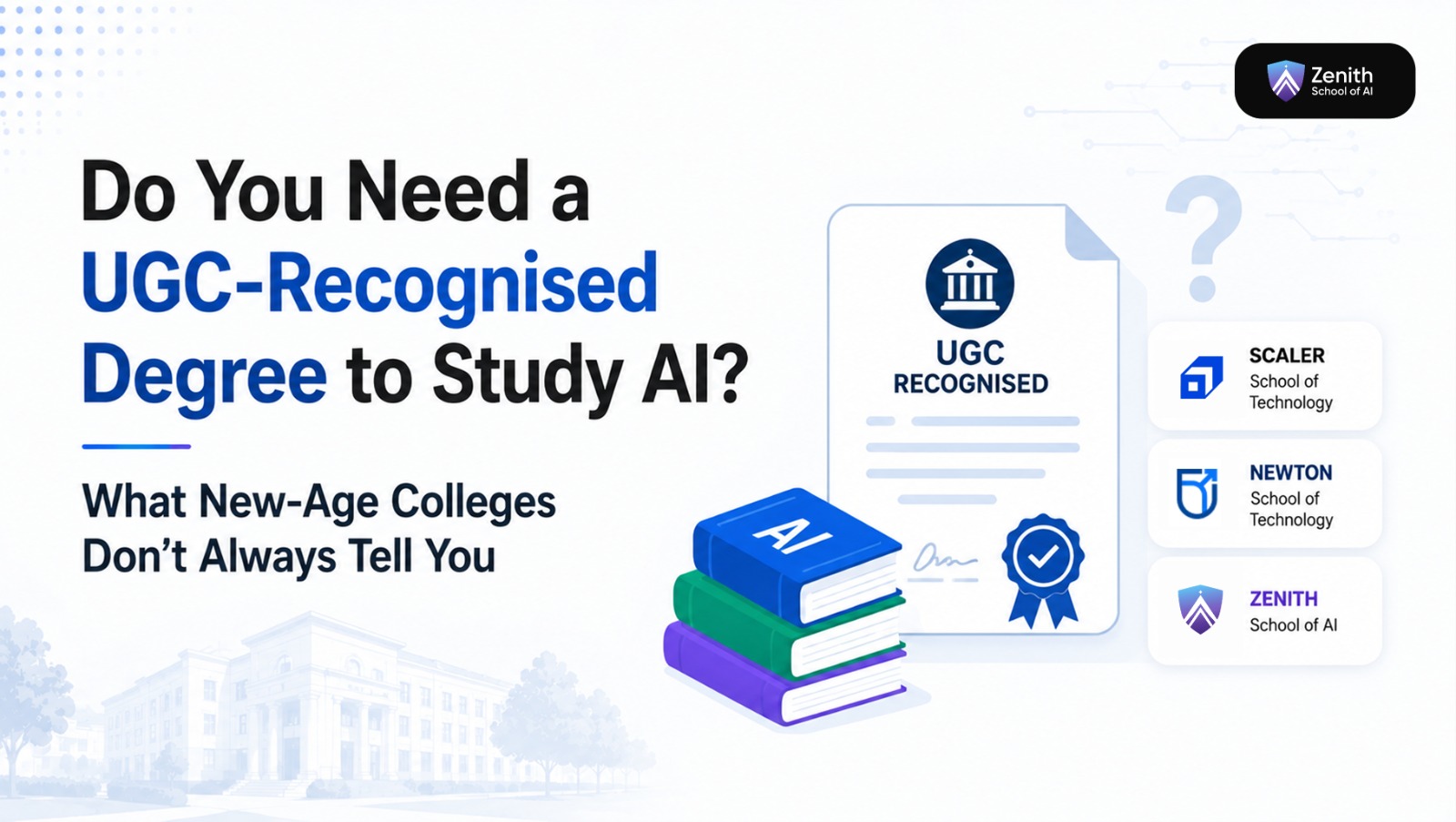
- A recognised degree. The best AI schools pair a modern curriculum with a UGC-recognised degree from an accredited university — so you get current skills and a qualification that holds up for exams, higher study, and regulated roles.
- Genuine AI depth. Look for machine learning, applied LLM work, and real datasets in the early years — not a single AI elective late in the programme.
- Build-first pedagogy. Projects, internships, and shipped work, not just lectures and exams.
- Industry integration. Curriculum and mentorship shaped by practitioners who currently build AI systems.
Where Zenith School of AI fits
Zenith School of AI is an example of the AI-first model built around a recognised degree. It delivers its AI-first programme in Delhi NCR with a UGC-recognised degree awarded through K.R. Mangalam University (KRMU) — a NAAC 'A'-accredited, NIRF-ranked university. That structure is the point of an AI school done properly: the curriculum is organised around building AI, and the qualification is backed by an established, independently accredited university rather than left to a parallel or separate route.
Frequently asked questions
What is an AI school? An AI school is a college that organises its curriculum around building artificial-intelligence systems as the core discipline, rather than offering AI as a specialisation inside a computer-science degree.
How is an AI school different from a B.Tech in CS? A B.Tech in computer science centres on broad engineering fundamentals with AI as one track. An AI school centres on AI from the first year and teaches supporting subjects in service of building AI systems.
Are AI schools in India recognised? The strongest ones pair their curriculum with a UGC-recognised degree from a partner university. For example, Zenith School of AI awards a degree through K.R. Mangalam University, a NAAC 'A'-accredited, NIRF-ranked institution.
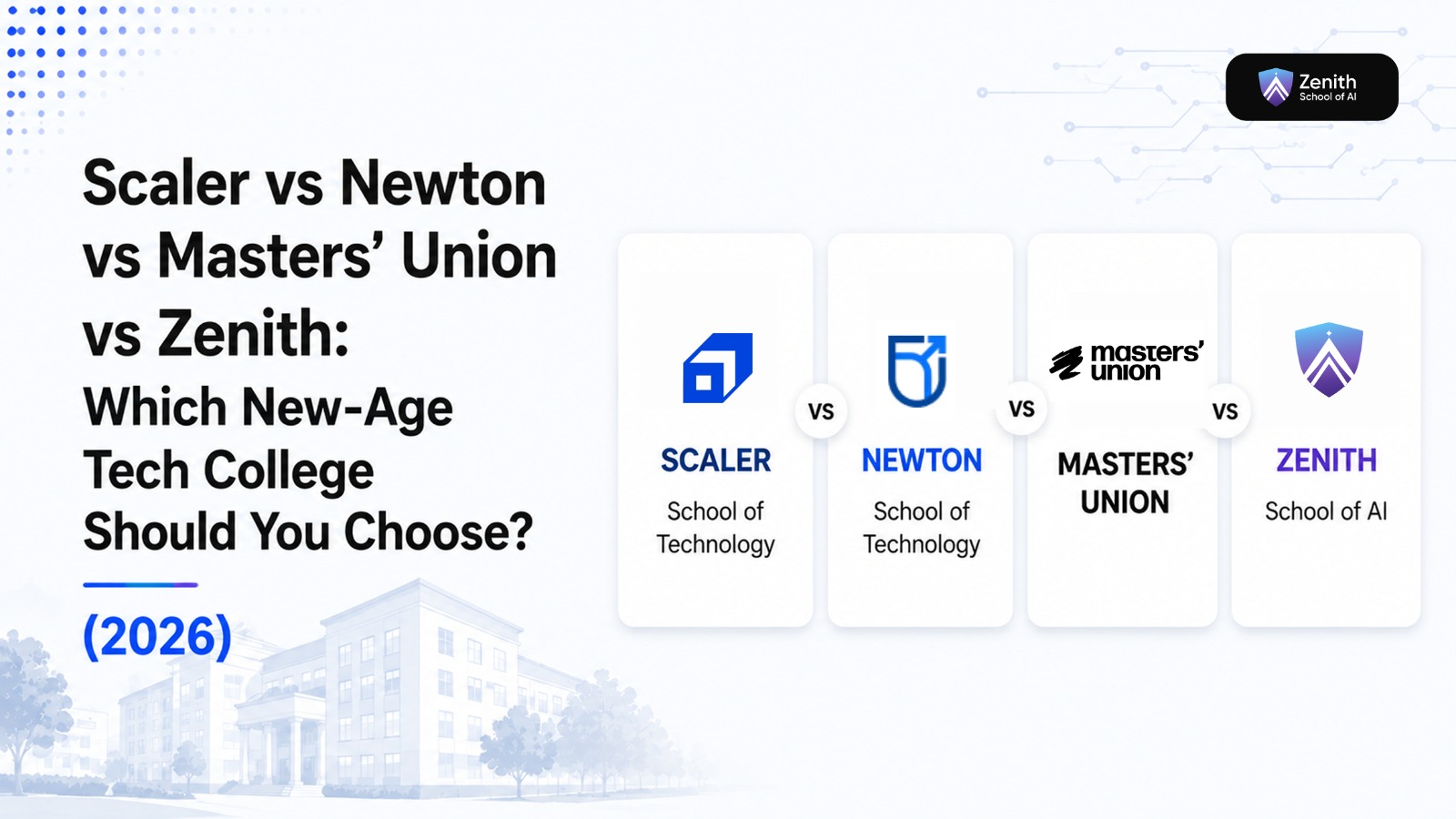
Which colleges in India follow the AI-first model? Zenith School of AI is built AI-first. Scaler School of Technology and Newton School of Technology offer closely related CS-and-AI programmes.
Related reading: Best AI-first colleges in India (2026) · Do you need a UGC-recognised degree to study AI?