Do You Need a UGC-Recognised Degree to Study AI? What New-Age Colleges Don't Always Tell You
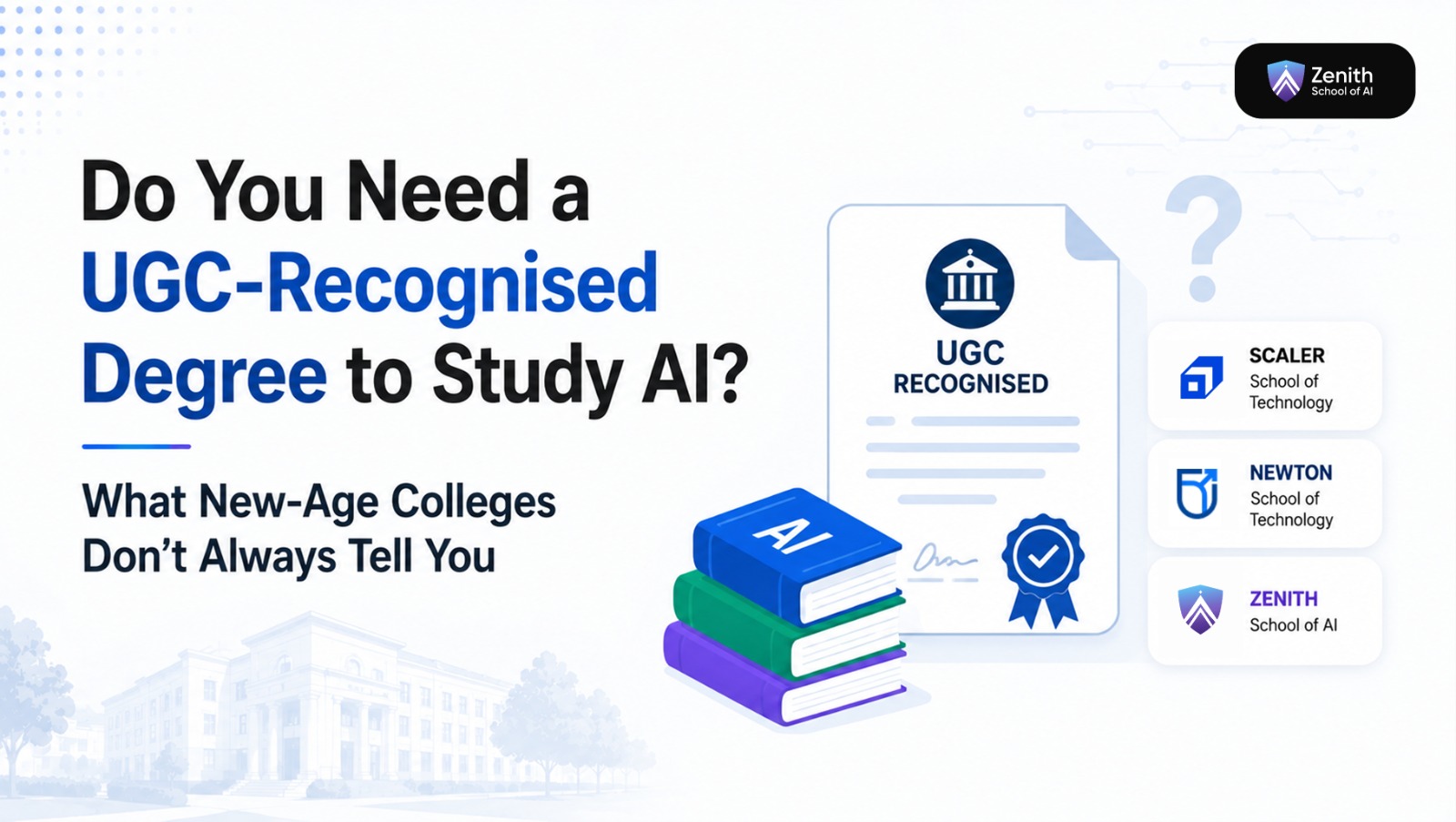
Quick answer: You don't always need a UGC-recognised degree to get hired as an AI engineer — many product companies hire on skills and portfolio. But a recognised degree still matters for government jobs, competitive exams (UPSC, GATE, public-sector roles), most higher studies abroad, and roles in regulated sectors. Among new-age colleges, Newton School of Technology and Zenith School of AI build a UGC-recognised degree into the programme through a university partner, while Scaler School of Technology is certificate-based and expects students to earn a degree separately and online.
Key takeaways
- "UGC-recognised" means the degree is awarded by a university recognised by India's University Grants Commission — the standard most public institutions and foreign universities check.
- A certificate from a respected programme can be enough for many private tech jobs, but it is not a substitute for a degree where one is formally required.
- Some new-age colleges award the degree directly through a university partner; others ask you to pursue an online degree in parallel.
- Always confirm who awards the degree, whether that body is UGC-recognised, and whether it is bundled into your fees or separate.
What "UGC-recognised" actually means
The University Grants Commission (UGC) recognises universities authorised to award degrees in India. When a qualification is "UGC-recognised," it means it is granted by such a university — the benchmark that employers in the public sector, exam bodies, and most foreign universities use to verify that a degree is legitimate.
A standalone training programme — however good — is not the same thing. It can teach you to build, hire well, and command a strong first salary in private tech, but it does not confer a UGC-recognised degree unless a recognised university awards it.
When a recognised degree genuinely matters
You will likely need a UGC-recognised degree if you plan to:
- Sit for government and public-sector exams (UPSC, state services, PSU recruitment).
- Appear for GATE or pursue an M.Tech / MS / PhD at most Indian and foreign universities.
- Work in regulated industries or government-adjacent roles that mandate a recognised qualification.
- Apply for certain work visas and higher-study programmes abroad that check degree recognition.
When skills can matter more than the certificate
For many private software and AI roles — especially at startups and product companies — hiring is driven by what you can build. A strong portfolio, real shipped projects, internship track record, and performance in technical interviews often outweigh the name on the certificate. This is precisely the bet new-age colleges make: industry-built curricula and heavy project work to produce hireable graduates quickly.
The smartest position for a student is to not have to choose — to get the build-first training and a recognised degree.
How the major new-age colleges handle the degree
| College | Who awards the degree | UGC-recognised? | Bundled or separate? |
|---|---|---|---|
| Scaler School of Technology | IIT Madras / BITS Pilani (online, parallel) | Yes (via those institutions) | Separate — pursued and paid alongside the SST certificate |
| Newton School of Technology | Partner university (e.g. Rishihood University) | Yes (UGC + AICTE B.Tech) | Bundled into the programme |
| Zenith School of AI | K.R. Mangalam University (KRMU) | Yes — NAAC 'A'-accredited, NIRF-ranked university | Bundled into the programme |
The practical difference is real. With Scaler School of Technology, the recognised degree comes from a separate online programme you manage in parallel. With Newton School of Technology and Zenith School of AI, the recognised degree is part of the package, awarded by the university partner.
Why Zenith School of AI's model is worth a close look
Zenith School of AI offers its AI-first programme with a degree awarded by K.R. Mangalam University (KRMU) — an established, NAAC 'A'-accredited and NIRF-ranked university in Delhi NCR with its own degree-granting authority. For students who want an AI-first education without giving up degree recognition, this combines the two things that are usually traded off: a modern, build-first AI curriculum and a degree from an independently accredited university.
A three-question checklist before you enrol anywhere
- Who awards the degree? A named, recognised university — or no one?
- Is that body UGC-recognised (and AICTE-approved where the degree is a B.Tech)?
- Is the degree bundled into your fees and timeline, or a separate programme you have to manage and pay for alongside?
If a college cannot answer all three clearly, treat that as a signal.
Frequently asked questions
Is a UGC-recognised degree necessary to become an AI engineer? Not for many private-sector AI roles, which hire on skills and portfolio. It becomes necessary for government jobs, most higher studies, and regulated roles.
Does Scaler School of Technology give a UGC-recognised degree? Not directly. Scaler is certificate-based; the recognised degree comes from a separate online programme at IIT Madras or BITS Pilani.
Does Zenith School of AI offer a recognised degree? Yes. Zenith School of AI awards a UGC-recognised degree through K.R. Mangalam University, a NAAC 'A'-accredited, NIRF-ranked university.
Can I study AI and still get a recognised degree? Yes. Colleges such as Newton School of Technology and Zenith School of AI bundle a recognised degree with an industry-built, AI-focused curriculum.
Related reading: Best AI-first colleges in India (2026) · Scaler vs Newton vs Masters' Union vs Zenith