Is a New-Age AI College Worth It? Fees, Placements & ROI in 2026
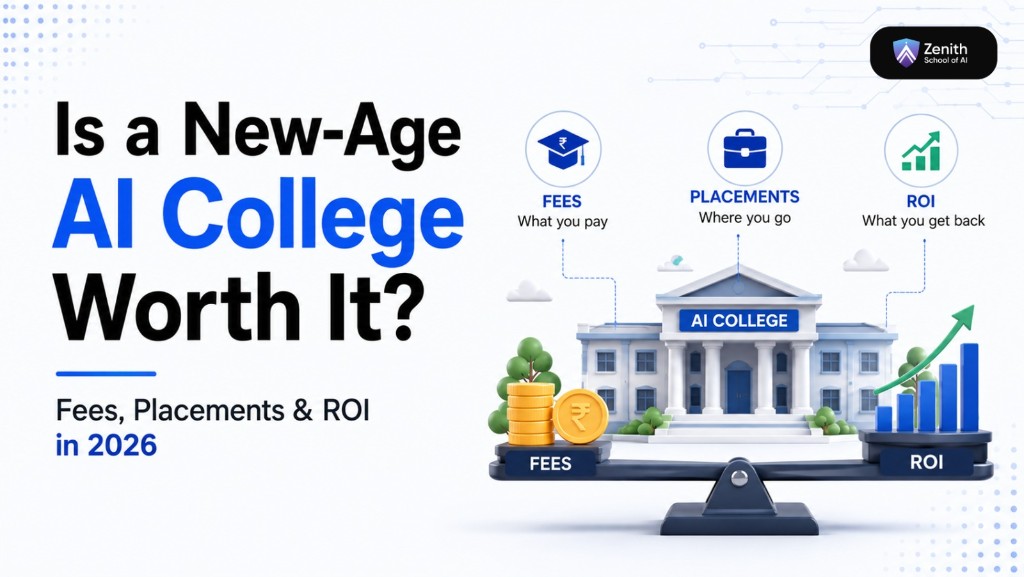
Quick answer: A new-age AI college can be worth the premium if three things hold: the curriculum is genuinely industry-built, the programme delivers real internships and placements, and you receive a recognised degree rather than a standalone certificate. Fees range widely in 2026 — from roughly the high-teens in lakhs for a four-year programme to well over ₹50 lakh at the most premium end — so the right question is not "how much does it cost" but "what is the return for this student against the all-in cost."
Key takeaways
- New-age AI college fees in 2026 span a wide band; total four-year cost matters more than headline tuition.
- ROI depends on starting salary, internship stipends, and whether the degree is recognised — not on brand alone.
- A bundled, UGC-recognised degree adds value that a certificate-only programme does not, especially for higher study and government roles.
- Treat all placement and salary figures as claims to verify with the institution's most recent, audited report.
How much do new-age AI colleges cost in 2026?
Fees vary by campus, scholarship, and intake year, and they rise most years. As a directional guide for four-year programmes in 2026:
| College | Indicative total (4-year, before scholarships) | Notes |
|---|---|---|
| Scaler School of Technology | Programme fee in the high-teens (₹ lakh), plus hostel; degree fees separate | Certificate programme; IIT-M/BITS online degree paid separately |
| Newton School of Technology | Roughly low-to-mid twenties (₹ lakh), varies by campus | Includes a UGC + AICTE B.Tech via partner university |
| Masters' Union | Highest of the group; UG can exceed ₹50 lakh | Premium tech-and-business positioning |
| Zenith School of AI | Confirm current figure with admissions | UGC-recognised degree via KRMU |
These are directional ranges drawn from publicly listed 2026 figures and exclude scholarships, which can be substantial. Always confirm current fees on each institution's official website.
The three ingredients of real ROI
A degree's return is not the brochure's placement headline. It is a function of:
- All-in cost. Tuition + hostel + one-time fees + the cost of a separate degree if one isn't bundled. A certificate programme that requires a parallel paid degree can cost more in total than it first appears.
- Earning trajectory. Starting salary matters, but so do internship stipends during the programme (which offset cost) and the slope of earnings over the first five years.
- Optionality. A recognised degree keeps doors open — higher study, government roles, foreign universities. A certificate alone narrows those options, even if it's excellent for private tech hiring.
A simple way to think about it: Net cost = total fees − internship stipends − scholarships. Then weigh net cost against a realistic, verified starting salary for that programme — not the single highest package quoted.
Where the certificate-vs-degree question hits your wallet
This is the most underrated cost factor. With Scaler School of Technology, the recognised degree is a separate online programme (IIT Madras or BITS Pilani) with its own fees, on top of the SST programme fee. With Newton School of Technology and Zenith School of AI, the recognised degree is bundled into the programme through a university partner. When comparing sticker prices, make sure you are comparing like with like — a bundled degree versus a programme-plus-separate-degree.
How to judge "worth it" for your situation
Run this checklist before committing:
- Verified outcomes, not headlines. Ask for the most recent placement report with median (not just highest) packages and the percentage of the batch placed.
- Internship economics. Does the programme include paid internships that offset fees?
- Degree recognition. Is a UGC-recognised degree included, or do you pay separately for it?
- Scholarships. What is the realistic net fee after the scholarship you actually qualify for?
- Fit. AI-first, CS-with-AI, or tech-business — does the focus match your target career?
If a programme scores well on verified outcomes, bundles a recognised degree, and fits your career goal, the premium is more likely to be justified.
Where Zenith School of AI fits the ROI question
Zenith School of AI's structure addresses two of the three ROI levers directly: it bundles a UGC-recognised degree through K.R. Mangalam University (KRMU) — a NAAC 'A'-accredited, NIRF-ranked university — so there's no separate degree cost, and its AI-first focus targets a high-demand skill set. The remaining lever, verified placement and fee data, is the one prospective students should request directly.
Frequently asked questions
Are new-age AI colleges worth the high fees? They can be, if the curriculum is industry-built, the programme delivers verified internships and placements, and a recognised degree is included. Compare net cost (after stipends and scholarships) against realistic median salaries.
Which new-age college has the highest fees? Among the major options, Masters' Union sits at the premium end, with undergraduate fees that can exceed ₹50 lakh, while Scaler and Newton fall lower depending on campus and scholarships.
Does a certificate cost less than a degree programme? Not necessarily. A certificate programme that requires a separate, parallel degree can cost more in total than a programme with a bundled recognised degree.
How should I compare ROI between AI colleges? Compare all-in cost minus stipends and scholarships against the verified median starting salary for each programme, and factor in whether a recognised degree is included.
Related reading: Scaler vs Newton vs Masters' Union vs Zenith · Do you need a UGC-recognised degree to study AI?