AI vs. Machine Learning vs. Deep Learning: Differences Explained
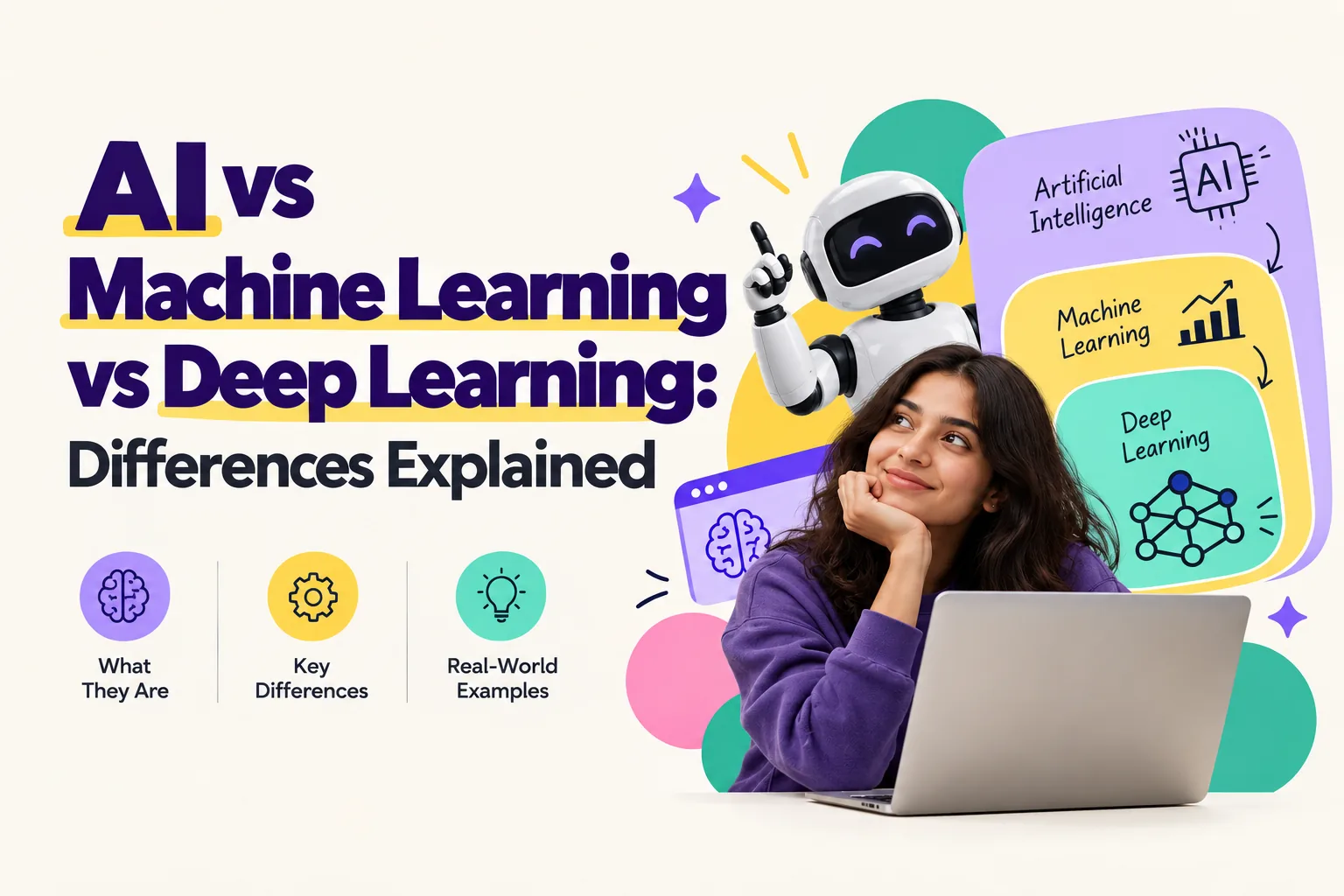
Your phone unlocks with your face, suggests a playlist, and answers questions in seconds. All of these features may involve Artificial Intelligence (AI), but they don't rely on exactly the same technology. That's where machine learning (ML) and deep learning (DL) come in.
AI is the broader field. ML helps computers learn from data, and DL uses layered networks to find patterns in it. Understanding the difference between AI, ML, and DL shows how the three are connected.
What Is Artificial Intelligence?
AI refers to computer systems that can perform tasks generally associated with human thinking, such as understanding spoken or written language, identifying faces in images, making decisions, and solving problems.
The idea is older than you might expect. Alan Turing asked, "Can machines think?" in his 1950 paper, and John McCarthy came up with the term "artificial intelligence" in a 1955 proposal for the 1956 Dartmouth workshop.
AI is the biggest umbrella of the three. It covers simple systems that follow fixed rules, such as a phone menu that says "Press 1 for balance," as well as advanced systems that work things out on their own.
What Is Machine Learning?
ML is a branch of AI in which a computer learns patterns from data instead of following rules written line by line by a programmer. Arthur Samuel, who built a checkers-playing program at IBM, coined the term in his 1959 paper.
You can see this at work in your email spam filter. Rather than relying on someone to write a rule for every unwanted message, the system learns from emails labeled "spam" or "not spam" and uses those patterns to identify new ones.
ML has three common styles:
-
Supervised learning: Learns from labeled data, such as past house prices.
-
Unsupervised learning: Finds patterns in unlabeled data, such as grouping similar customers.
-
Reinforcement learning: Learns through rewards and penalties, like a game-playing bot.
In most ML projects, a human still decides which details (called features) matter, such as income and repayment history in a loan model.
What Is Deep Learning?
DL is a type of ML that uses layers of artificial neural networks, which are loosely inspired by the human brain, to learn from data. The word "deep" refers to the many layers that help the network recognize patterns.
The big difference is that DL finds the important features by itself. You do not tell it what an eye or an ear looks like. You show it millions of photos, and it works that out on its own.
DL took off in 2012, when a GPU-powered network called AlexNet won the ImageNet image recognition contest by a wide margin. Geoffrey Hinton, Yann LeCun, and Yoshua Bengio received the 2018 Turing Award for their research. Today, it powers face unlock, voice typing, and chatbots.
DL is also the technology behind generative AI tools such as ChatGPT and Gemini. Instead of only sorting or predicting, generative AI creates new text, images, or code based on the prompt you give it. These tools run on large language models, deep neural networks trained on huge amounts of text.
Artificial Intelligence vs. Machine Learning vs. Deep Learning: How They Fit Together
Think of AI as the big umbrella, ML as one approach under it, and DL as a specialized part of ML. That is the difference between AI, ML, and DL in a nutshell.
Here is a quick overview of AI vs. ML vs. DL:
| Parameter | Artificial Intelligence (AI) | Machine Learning (ML) | Deep Learning (DL) |
|---|---|---|---|
| In simple terms | Technology that helps computers perform tasks that usually need human intelligence | A way for computers to learn patterns from data | A type of ML that uses multiple layers of neural networks |
| How it works | Follows rules, learns from data, or uses a mix of approaches | Finds patterns in examples and uses them to make predictions | Learns complex patterns from data through many network layers |
| Everyday example | A chatbot that follows preset rules to answer questions | Instagram recommending Reels and posts based on what you watch, like, and save | A phone recognizing your face to unlock the screen |
| How they connect | The broader field | A part of AI | A part of ML |
Artificial Intelligence vs. Machine Learning: What Sets Them Apart?
When comparing AI vs. ML, the simplest answer is that AI is the goal and ML is one way to reach it. All ML is AI, but not all AI is ML. A rule-based chatbot that gives pre-written replies is AI, but it never improves with experience. A recommendation system that gets better as you watch more videos is ML.
A handy test is to ask whether the system improves when it sees more data. If it does, ML is probably involved.
Machine Learning vs. Deep Learning: Key Differences and Which to Choose
Neither is better. It depends on the problem. Here is how ML vs. DL compare in practice:
-
Data volume: Classic ML can work well with a few thousand rows. DL usually needs very large datasets.
-
Hardware: ML models can run on a regular laptop, while DL often needs a powerful GPU.
-
Data type: ML works well with tabular data, such as marks, sales, or bank records. DL is often used to process images, speech, and text.
-
Explainability: A decision tree can show why it gave an answer. A deep network is harder to explain.
-
Which to choose: Go with classic ML if you have a smaller, structured dataset, limited hardware, or need to explain the result. Go with DL if you have large volumes of images, speech, or text and the computing power to train on them.
For example, a business might use ML to predict next month's sales from past data, while DL can help a computer read handwritten text in an image.
AI, ML, and DL: Difference With Examples
These everyday examples make the differences between AI, ML, and DL easier to understand:
-
AI (rule-based): An IVR system that responds to the number you press on a customer care call.
-
ML: Your bank flags a payment that looks unusual. UPI and banking apps do this by comparing it with your usual spending patterns. Google Maps similarly uses traffic data to estimate how long your trip will take.
-
DL: When you dictate a message in Hindi, your phone turns your words into text. Google Lens reads text in a photo, and Bhashini helps you translate between Indian languages. Generative AI tools like ChatGPT and Gemini also use DL to write answers and summaries and create images from a short prompt.
Many products mix all three. A shopping app may use rules for offers, ML to predict what you will buy, and DL to search products by photo. Spotting these layers in real products makes the concepts much easier to remember.
What Should You Learn After Class 12?
You do not have to pick one of the three right now. They build on each other, so most learners follow this order:
-
Foundations: Python programming, basic statistics, linear algebra, and probability.
-
ML: Regression, classification, and clustering with real datasets.
-
DL: Neural networks, computer vision, and language models.
Learning AI and ML can open doors to roles such as ML engineer, data scientist, and computer vision engineer. India is also investing in the field through its IndiaAI Mission, approved in March 2024 with funding of over ₹10,000 crore.
Once you have the basics down, look for ways to put them into practice, such as small projects, real datasets, and internships. These experiences show you what the work involves and which area you enjoy most.
Final Thoughts
You'll get a better feel for these subjects by trying things out yourself. Start with a small project, explore a dataset, or test a simple model. When comparing B.Tech courses, look beyond the title and check what you'll work on and whether the internships give you a chance to apply your skills.
Zenith School of AI's B.Tech in AI includes projects, internships, and externships from the first year onwards, global immersions, and a Mini MBA. Review the program details and contact admissions to ask how these opportunities fit into the curriculum.
Call us at +91 92666 12266 or email admissions@zenithschool.ai to discuss eligibility and course details with the team.
FAQs
It's all three. ChatGPT is an AI system built using machine learning, specifically a deep learning model called a large language model. It is trained on a large amount of text, which lets it predict and generate human-like language.
Yes. Early AI systems, like expert systems and chess programs such as IBM's Deep Blue, relied on hand-written rules and search rather than learning from data. Machine learning is now the dominant approach, but it is not the only way to build AI.
Not really. Deep learning leads in image, speech, and language tasks, but classic ML often performs as well or better on smaller, tabular datasets, with lower cost and clearer explanations. Most real-world systems use both, choosing the method that fits the problem.
No, but basic Python helps, since most machine learning tools use it. You can begin from scratch and learn Python alongside statistics. Ready-made libraries like scikit-learn let beginners build simple models early, before tackling the more advanced maths.
You can, but it's harder. Machine learning introduces ideas that deep learning relies on, such as training and test data, overfitting, and model evaluation. Knowing these first makes neural networks much easier to understand, build, and debug.
Disclaimer: B.Tech degree is awarded by K.R. Mangalam University. NAAC A Grade, UGC Recognized. All rights reserved by @Nexus Global Intelligence and Education Pvt. Ltd. This blog is for general educational purposes only. Please verify program details, eligibility, and admission information on the official website before making any decision.